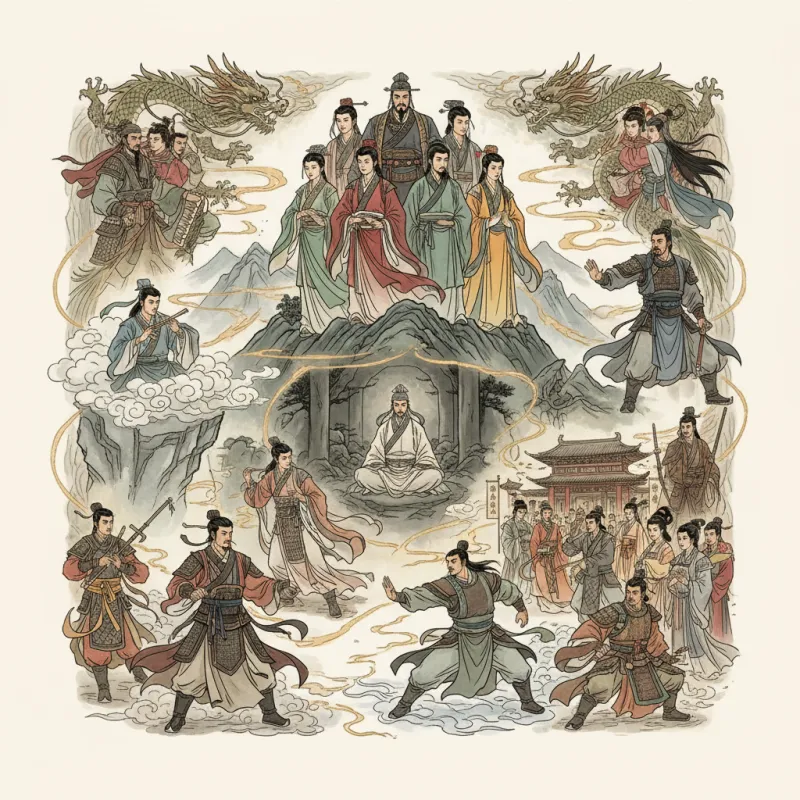
What if I told you that the beggar who teaches Yang Guo a dog-beating technique in The Return of the Condor Heroes is the same man who once stood beside Genghis Khan at the siege of Samarkand? Or that the sword manual hidden in a Shaolin temple connects five different novels across four centuries? Jin Yong didn't just write martial arts novels — he built a literary universe so intricate that readers are still discovering new connections forty years after his last book was published.
The Condor Trilogy: Where It All Begins
The Condor Trilogy (射雕三部曲, Shè Diāo Sānbùqǔ) is Jin Yong's most explicit experiment in continuity. Legends of the Condor Heroes (射雕英雄传, Shè Diāo Yīngxióng Zhuàn) introduces us to Guo Jing and Huang Rong in the 1200s, during the Mongol conquest of China. Twenty years later, The Return of the Condor Heroes (神雕侠侣, Shén Diāo Xiálǚ) shows us their daughter Guo Fu and the orphan Yang Guo, whose father was Guo Jing's sworn brother. Then The Heaven Sword and Dragon Saber (倚天屠龙记, Yǐtiān Túlóng Jì) jumps forward a century to reveal that the legendary weapons everyone's fighting over were forged from Guo Jing and Yang Guo's swords — melted down after the fall of Xiangyang.
This isn't just fan service. Jin Yong uses these connections to explore how heroism changes across generations. Guo Jing is the straightforward patriot who dies defending a doomed city. Yang Guo is the rebellious anti-hero who saves the day but refuses to play by society's rules. Zhang Wuji, a century later, inherits their weapons but not their certainty — he's paralyzed by moral complexity in a way his predecessors never were. The trilogy traces the evolution of the xia (侠, xiá) ideal from simple loyalty to something far more ambiguous.
The Nine Yang Manual: A Thread Through Time
Here's where it gets interesting. The Nine Yang Manual (九阳真经, Jiǔ Yáng Zhēn Jīng) appears in three different novels, and each appearance reveals something new about Jin Yong's world-building.
In The Return of the Condor Heroes, we learn that a Shaolin monk named Jueyuan accidentally discovered the manual hidden in the margins of a Buddhist sutra. He memorized it, then died before he could write it down. His two disciples — who would become Zhang Sanfeng and Guo Xiang — each remembered half.
Fast forward to The Heaven Sword and Dragon Saber. Zhang Wuji finds the complete manual hidden inside a white ape's belly on Ice-Fire Island. This version was written by Jueyuan before his death, which contradicts what we learned in the previous novel. Jin Yong never explains this discrepancy, and honestly? I think he did it on purpose. The manual becomes a kind of mythical object, existing in multiple versions simultaneously, like the historical Buddha's teachings that were transmitted orally before being written down.
Then there's Demi-Gods and Semi-Devils (天龙八部, Tiānlóng Bābù), set a century before the Condor novels. Here we meet Xiaoyaozi, whose martial arts clearly influenced what would later become the Nine Yang Manual. Jin Yong wrote Demi-Gods after the Condor Trilogy, deliberately planting seeds that would grow into future stories. It's a prequel that recontextualizes everything we thought we knew.
Dugu Qiubai: The Invisible Master
Dugu Qiubai (独孤求败, Dúgū Qiúbài) — "Lonely Seeking Defeat" — never appears in any Jin Yong novel. He's been dead for decades or centuries by the time the stories begin. Yet his influence ripples through at least four books.
In The Return of the Condor Heroes, Yang Guo discovers Dugu's sword tomb and learns his techniques from a giant condor who was once his companion. In The Smiling, Proud Wanderer (笑傲江湖, Xiào'ào Jiānghú), Feng Qingyang teaches Linghu Chong a sword style that he claims comes from Dugu's tradition. In The Deer and the Cauldron (鹿鼎记, Lù Dǐng Jì), set centuries later, characters still speak of Dugu as the greatest swordsman who ever lived.
What's brilliant about this is that Dugu becomes more powerful because he's absent. He's pure legend, untainted by the messy reality of actually appearing on the page. Every character who learns his techniques interprets them differently — Yang Guo uses them with raw emotion, Linghu Chong with playful improvisation, Feng Qingyang with philosophical detachment. Dugu is less a person than a principle: the idea that true mastery means transcending technique entirely.
The progression of Dugu's swords tells its own story. He starts with a sharp blade, moves to a soft sword, then a heavy iron sword, then a wooden sword, and finally no sword at all. It's a metaphor for spiritual development that Jin Yong threads through multiple novels without ever making it explicit. Readers who pay attention realize that the philosophy of martial arts in Jin Yong's universe is cumulative — each generation builds on what came before.
The Shaolin-Wudang Rivalry: A 400-Year Grudge
The tension between Shaolin Temple and Wudang Mountain runs through at least five novels, and it's rooted in a single event: Zhang Sanfeng's departure from Shaolin.
In The Heaven Sword and Dragon Saber, we learn that Zhang Sanfeng (张三丰, Zhāng Sānfēng) was once a Shaolin monk who left to found Wudang after his martial brother was killed by Shaolin's own rigidity. This happened around 1280. By the time of The Smiling, Proud Wanderer (set in the Ming dynasty, roughly 1500s), the rivalry has calcified into institutional hatred. Shaolin and Wudang are the two great orthodox schools, but they can barely cooperate even when facing a common enemy.
What's fascinating is how Jin Yong uses this rivalry to explore different approaches to martial arts philosophy. Shaolin emphasizes hard external training and Buddhist discipline. Wudang focuses on soft internal cultivation and Taoist spontaneity. But here's the twist: Zhang Sanfeng learned his internal arts from the Nine Yang Manual, which was hidden in a Shaolin sutra. The two schools are fighting over a distinction that's ultimately artificial. They're branches of the same tree who've forgotten their common root.
This theme reaches its peak in The Book and the Sword (书剑恩仇录, Shū Jiàn Ēnchóu Lù), where Chen Jialuo must navigate between different martial arts factions who are more interested in their own prestige than in fighting the Qing invaders. Jin Yong is making a point about how institutions ossify and forget their original purpose — a theme that resonates beyond martial arts into politics, religion, and culture.
The Ming-Qing Transition: Where Timelines Converge
Four of Jin Yong's novels are set during the fall of the Ming dynasty and the rise of the Qing: The Deer and the Cauldron, The Book and the Sword, Fox Volant of the Snowy Mountain (雪山飞狐, Xuěshān Fēihú), and The Young Flying Fox (飞狐外传, Fēihú Wàizhùan). This isn't coincidental. Jin Yong was obsessed with this period because it represents the moment when Han Chinese rule ended and Manchu "foreigners" took over — a trauma that echoed through Chinese history for centuries.
The Deer and the Cauldron is set in the 1680s, during the early Qing. Wei Xiaobao, the protagonist, is a Han Chinese who serves the Manchu emperor Kangxi. The novel is full of references to anti-Qing resistance movements that will appear in later books. The Heaven and Earth Society (天地会, Tiāndì Huì) that Wei Xiaobao infiltrates is the same organization that Chen Jialuo leads in The Book and the Sword, set seventy years later.
Here's where it gets meta: The Book and the Sword was Jin Yong's first novel, published in 1955. The Deer and the Cauldron was his last, published in 1972. He spent seventeen years and fourteen novels building up to a prequel of his own first work. The Heaven and Earth Society that seemed like a simple plot device in 1955 became, by 1972, a complex meditation on resistance and collaboration under foreign rule.
The Hu Fei Connection: Generational Echoes
Fox Volant of the Snowy Mountain and The Young Flying Fox are technically two separate novels, but they're really one story told from different angles. Fox Volant begins in media res with a confrontation in a snowy mountain inn. The Young Flying Fox is a prequel that explains how everyone ended up there.
But the connection goes deeper. Hu Fei's father, Hu Yidao, appears in The Young Flying Fox as a tragic hero who dies young. His wife, Hu Fei's mother, is the daughter of a Miao chieftain — connecting these novels to the ethnic minority themes that Jin Yong explores in Demi-Gods and Semi-Devils and The Book and the Sword. The sword technique that Hu Fei uses was created by Miao Renfeng, who learned it from... well, the lineage gets complicated, but it ultimately traces back to martial arts traditions from the Song dynasty.
What I love about this is how Jin Yong uses family lineages to create continuity without being heavy-handed about it. Hu Fei doesn't spend the novel talking about how he's connected to other heroes. He's just living his life, and readers who know the broader universe can appreciate the echoes.
The Ling Tuisi Problem: When Timelines Don't Match
Not all of Jin Yong's connections are seamless. In The Smiling, Proud Wanderer, there's a character named Ling Tuisi who uses a technique called the Sunflower Manual (葵花宝典, Kuíhuā Bǎodiǎn). This manual is supposed to be incredibly ancient, passed down through generations. But the timeline doesn't quite work — if you trace back when it was created versus when the novel is set, there are gaps that don't add up.
Some fans see this as a mistake. I think it's evidence of something more interesting: Jin Yong was revising his novels throughout his life, adding connections retroactively. The 1970s versions of his books contain references that weren't in the 1950s originals. He was building the shared universe in real-time, sometimes creating contradictions in the process.
This is actually very true to how oral storytelling traditions work. The Romance of the Three Kingdoms and Water Margin — the classical novels that inspired Jin Yong — are full of similar inconsistencies because they were compiled from multiple sources over centuries. Jin Yong was doing the same thing, just faster and more deliberately.
The Philosophical Thread: What Connects Everything
Beyond plot connections, there's a deeper thematic unity to Jin Yong's novels. Every single one explores the tension between individual freedom and social obligation, between martial power and moral responsibility, between tradition and innovation.
Guo Jing chooses duty over survival. Yang Guo chooses love over reputation. Linghu Chong chooses friendship over power. Wei Xiaobao chooses pragmatism over principle. Zhang Wuji can't choose at all. Each protagonist represents a different answer to the same fundamental question: what does it mean to be a xia in a world that doesn't reward heroism?
The martial arts themselves are a metaphor for this philosophical journey. Characters who cling too tightly to orthodox techniques become rigid and vulnerable. Those who abandon tradition entirely become powerful but unmoored. The greatest masters — Dugu Qiubai, Zhang Sanfeng, Feng Qingyang — are the ones who transcend the dichotomy entirely.
This is why the connections between novels matter. They're not just Easter eggs for fans. They're Jin Yong's way of showing that these questions persist across centuries, that each generation must grapple with them anew, and that the answers are never simple. The shared universe isn't just a narrative technique — it's a philosophical argument about continuity and change, tradition and rebellion, that plays out across 700 years of fictional history.
When you read Jin Yong's novels in chronological order (by setting, not publication), you're watching Chinese civilization itself evolve, from the Song dynasty's idealism through the Ming-Qing transition's trauma to the Qing dynasty's uneasy compromise. The hidden connections aren't just fun trivia. They're the architecture of a world where history matters, where actions have consequences that ripple through generations, and where the past is never really past.
Related Reading
- The Biggest Unsolved Mysteries in Jin Yong Novels
- Alternative Endings Fans Wish Jin Yong Had Written
- Fan Debates That Have Lasted Decades
- Jin Yong's Fan Theories: The Debates That Never End
- Jin Yong on Screen: The Best Film Adaptations
- The Timeless Appeal of Jin Yong's Wuxia Novels: Martial Arts, Characters, and Storylines
- Why Every Chinese Person Knows Jin Yong