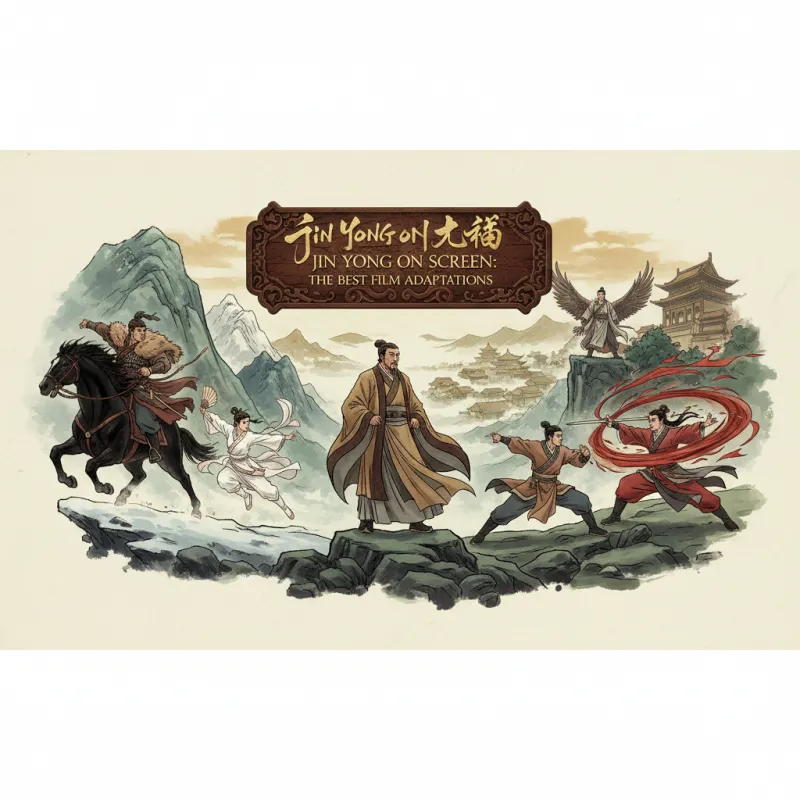
Picture this: A one-armed swordsman stands atop a windswept cliff, his blade catching the dying light as enemies circle below. For decades, this image—and countless others from Jin Yong's wuxia universe—has leapt from page to screen, spawning over 100 film and television adaptations since the 1950s. But here's the uncomfortable truth: most of them are forgettable at best, unwatchable at worst. The gap between Jin Yong's intricate prose and what appears on screen is often a chasm of missed opportunities, wooden acting, and special effects that age like milk. Yet scattered among the mediocrity are genuine masterpieces that not only capture the spirit of the novels but elevate them into something transcendent.
The Golden Age: Shaw Brothers and the Birth of Wuxia Cinema
The Shaw Brothers studio didn't just adapt Jin Yong—they essentially invented the visual language of wuxia cinema. Their 1960s and 70s productions, particularly director Chang Cheh's work, established the wire-work choreography, dramatic zooms, and blood-splattered aesthetics that would define the genre for generations. The 1967 adaptation of One-Armed Swordsman (though based on a different author's work) set the template, but it was their Jin Yong adaptations that truly mattered.
The Brave Archer series (1977-1982), based on The Legend of the Condor Heroes (射雕英雄传, Shè Diāo Yīngxióng Zhuàn), remains the most ambitious attempt to translate Jin Yong's sprawling epic to film. Director Chang Cheh compressed the novel's intricate plot into four films, focusing on Guo Jing's transformation from bumbling youth to martial arts master. Alexander Fu Sheng's portrayal captured Guo Jing's earnest simplicity perfectly, while the film's elaborate tournament sequences brought the novel's martial arts philosophy to vivid life. Yes, the pacing is uneven and the special effects now look charmingly dated, but the emotional core remains intact.
The New Wave: Wong Kar-wai's Radical Reimagining
Then came 1994, and everything changed. Wong Kar-wai's Ashes of Time took Jin Yong's The Eagle-Shooting Heroes and deconstructed it into a meditation on memory, regret, and the passage of time. This wasn't adaptation—it was transformation. Wong stripped away the plot mechanics and focused entirely on the emotional landscapes of characters like Ouyang Feng (Leslie Cheung) and Huang Yaoshi (Tony Leung Ka-fai), rendering them as lonely figures haunted by choices they can't unmake.
Purists hated it. They wanted the Peach Blossom Island sequences, the martial arts tournaments, the intricate revenge plots. Instead, Wong gave them Christopher Doyle's sun-bleached cinematography, elliptical editing, and characters who speak in poetic fragments. The film bombed commercially but has since been recognized as one of the greatest wuxia films ever made—precisely because it understood that Jin Yong's real subject was never just kung fu, but the human heart's capacity for both nobility and self-destruction. For more on the philosophical underpinnings of these characters, see The Philosophy of Jin Yong's Martial Arts.
Television's Triumph: The 1983 Legend of the Condor Heroes
If we're being honest, television has always been the superior medium for Jin Yong adaptations. The novels are simply too dense, too character-rich, too plotted for two-hour films. The 1983 TVB adaptation of The Legend of the Condor Heroes, starring Felix Wong as Guo Jing and Barbara Yuen as Huang Rong, remains the gold standard against which all others are measured.
What made it work? First, the 59-episode format allowed the story to breathe. Every character got their moment—from the Seven Freaks of Jiangnan to the complex tragedy of Yang Kang. Second, the casting was impeccable. Felix Wong embodied Guo Jing's stubborn integrity without making him seem stupid, while Barbara Yuen's Huang Rong was clever without being insufferable. Third, and most crucially, the series understood that Jin Yong's novels work because they balance action with genuine emotional stakes. The romance between Guo Jing and Huang Rong develops slowly, earned through shared trials rather than manufactured drama.
The theme song, "A Lifetime's Quest" (铁血丹心, Tiě Xuè Dān Xīn), became so iconic that it's now inseparable from the novel itself. That's the mark of a successful adaptation—when it adds something to the source material rather than merely illustrating it.
The Mainland Mega-Productions: Spectacle Over Substance
Fast forward to the 2000s, and Chinese television discovered CGI. The results have been... mixed. The 2003 mainland adaptation of Demi-Gods and Semi-Devils (天龙八部, Tiānlóng Bā Bù) starring Hu Jun exemplifies both the promise and pitfalls of big-budget wuxia television. The production values were unprecedented—elaborate costumes, location shooting in actual historical sites, fight choreography that attempted to visualize the novels' fantastical martial arts techniques.
But something was lost in translation. The performances skewed melodramatic, the pacing dragged despite the 40-episode runtime, and the CGI effects—meant to bring techniques like the Six Meridians Divine Sword to life—often looked cartoonish. The 2013 remake starring Kim Joo-hyuk and Zhong Hanliang doubled down on the spectacle, adding even more elaborate effects and romantic subplots that Jin Yong never wrote. These adaptations treat the novels as raw material to be "improved" rather than texts to be honored.
The Curious Case of The Smiling, Proud Wanderer
The Smiling, Proud Wanderer (笑傲江湖, Xiào Ào Jiānghú) might be Jin Yong's most adapted novel, with over a dozen film and television versions since 1978. It's also the one that filmmakers consistently misunderstand. The novel is fundamentally about freedom—Linghu Chong's refusal to be bound by sect loyalty, political ambition, or even romantic convention. He's a drunk, a wanderer, a man who values friendship over power.
Yet most adaptations turn him into a conventional hero. The 1990 film Swordsman, produced by Tsui Hark and directed by King Hu, at least attempted something different by making the protagonist gender-ambiguous and focusing on the political machinations of the martial arts world. The 2001 television series starring Li Yapeng went the opposite direction, emphasizing romance and making Linghu Chong into a more traditional leading man. Neither quite captured the novel's anarchic spirit, though both have their merits. For deeper analysis of Linghu Chong's character, see The Unconventional Heroes of Jin Yong.
What Makes a Great Jin Yong Adaptation?
After watching dozens of these adaptations, certain patterns emerge. The best ones share several qualities: they respect the source material's complexity without being slavishly faithful; they understand that Jin Yong's martial arts are metaphors for philosophical and emotional conflicts; they cast actors who can convey interior life, not just strike poses; and they recognize that these stories work because they're fundamentally about people trying to live with honor in a dishonorable world.
The worst adaptations treat the novels as action-adventure templates, stripping away the historical context, philosophical depth, and moral ambiguity that make them literature rather than mere entertainment. They add unnecessary romantic subplots, simplify complex characters into heroes and villains, and rely on special effects to compensate for weak storytelling.
The Future of Jin Yong on Screen
With Jin Yong's passing in 2018, we've entered a new era of adaptations—ones made without the author's input or approval. The 2021 The Legend of the Condor Heroes: The Cadaverous Claws attempted a darker, more "realistic" take on the material, with mixed results. Streaming platforms like Netflix and iQiyi are developing new adaptations aimed at international audiences, which raises questions about how these quintessentially Chinese stories will translate across cultures.
What's certain is that filmmakers will keep returning to Jin Yong's novels, because they contain something essential—stories about loyalty, betrayal, love, and the search for meaning in a chaotic world. These themes are universal, even if the wuxia trappings are distinctly Chinese. The challenge is finding directors and actors who understand that Jin Yong wasn't just writing about people who could fly; he was writing about people who wanted to transcend their limitations, whether physical, moral, or spiritual. For more on Jin Yong's enduring influence, see Jin Yong's Legacy in Modern Chinese Culture.
The best Jin Yong adaptation might still be waiting to be made. But until then, we have Ashes of Time, the 1983 Condor Heroes, and a handful of others that remind us why these stories matter—not because they show us impossible martial arts, but because they show us recognizable human hearts.
Related Reading
- Exploring the Enduring Legacy of Jin Yong's Wuxia Novels
- Jin Yong's Influence on Asian Pop Culture
- Jin Yong's Writing Style: What Makes It Timeless
- The Literary Depth of Jin Yong's Martial Arts Fiction
- Exploring the Love Stories in Jin Yong's Wuxia Novels: Romance Amidst Adventure
- Ouyang Feng: The Western Venom