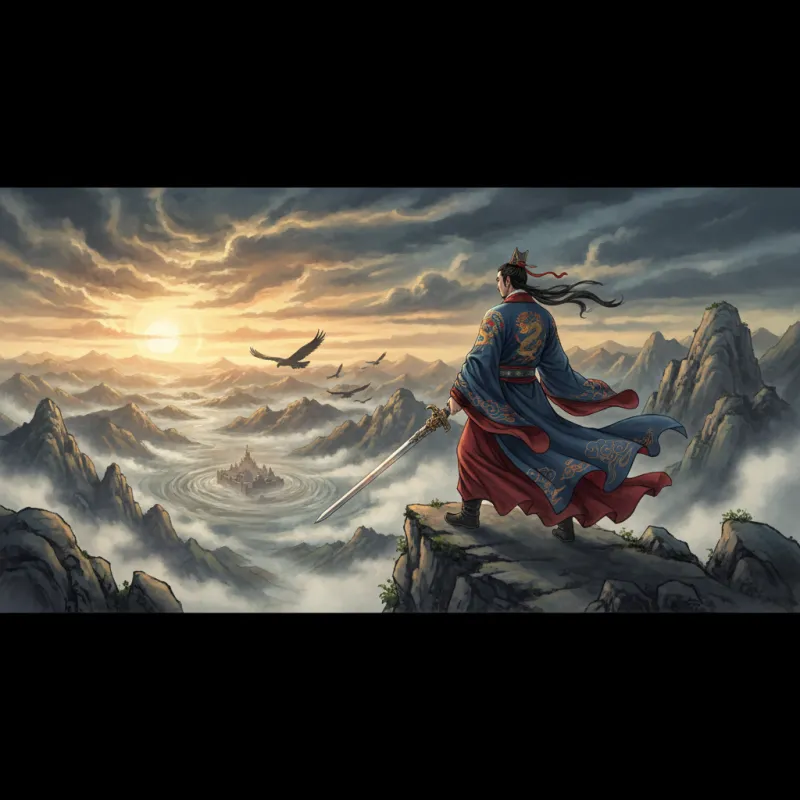
When Demi-Gods and Semi-Devils opens with the Shaolin abbot Xuanci presiding over a martial arts gathering, Jin Yong spends pages describing not the fighting techniques, but the political maneuvering, the unspoken hierarchies, the way different sects position themselves through seating arrangements and greeting protocols. This is not the work of a pulp writer churning out action sequences. This is a novelist who understands that power operates through ritual, that violence is always embedded in social structures, and that the most dangerous conflicts begin long before anyone draws a sword.
The Prejudice Against Genre Fiction
For most of the 20th century, Chinese literary critics dismissed Jin Yong's work with a wave of the hand. He wrote wuxia (武侠 wǔxiá) — martial arts fiction — which meant he wrote entertainment, not literature. The gatekeepers of Chinese letters reserved their praise for writers like Lu Xun, whose bitter social realism exposed China's wounds, or Ba Jin, whose family sagas chronicled the collapse of traditional society. These were serious writers addressing serious themes. Jin Yong? He wrote about people flying through the air and shooting energy beams from their palms.
This dismissal revealed more about the critics than the work. The assumption was that popular fiction couldn't be literary, that entertainment and artistry were mutually exclusive, that anything involving kung fu masters was inherently juvenile. It was the same prejudice that kept Dickens out of university syllabi for decades, the same snobbery that treated detective fiction as beneath critical attention until scholars finally noticed what Dorothy Sayers and Raymond Chandler were actually doing with language and structure.
The irony is that Jin Yong was doing exactly what the literary establishment claimed to value: creating psychologically complex characters, engaging with Chinese history and philosophy, experimenting with narrative structure, and writing prose that balanced accessibility with sophistication. He just happened to set these literary achievements in a world where people could fight on rooftops and survive poison with internal energy cultivation.
Historical Fiction as Literary Architecture
Jin Yong's novels are built on a foundation of meticulous historical research. The Legend of the Condor Heroes unfolds against the Mongol conquest of the Jin Dynasty in the early 13th century. The Duke of Mount Deer satirizes the early Qing Dynasty through the adventures of Wei Xiaobao, a character who embodies the moral compromises required to survive dynastic transition. Demi-Gods and Semi-Devils is set during the Song Dynasty's conflicts with the Liao and Western Xia kingdoms.
But Jin Yong doesn't use history as mere backdrop. He interrogates it. In The Deer and the Cauldron, the Kangxi Emperor — traditionally portrayed as one of China's greatest rulers — is shown as a clever but ruthless politician who consolidates power through manipulation and violence. The novel asks uncomfortable questions about what "great leadership" actually means, about whether the stability of empire justifies the brutality required to maintain it. This is not the work of a writer interested only in entertaining readers with sword fights.
Compare this to how Tolstoy uses the Napoleonic Wars in War and Peace, or how Hilary Mantel reconstructs Tudor England in the Thomas Cromwell trilogy. These writers are praised for their historical fiction because they use the past to examine timeless questions about power, loyalty, and moral choice. Jin Yong does exactly the same thing, but because his characters also practice martial arts, critics initially refused to take him seriously.
The historical detail in Jin Yong's work is staggering. He researched Song Dynasty military organization, Mongol battle tactics, Ming Dynasty secret police operations, and Qing Dynasty ethnic policies. His novels contain accurate references to historical figures, real battles, and documented political conflicts. When Guo Jing defends Xiangyang against the Mongols in The Return of the Condor Heroes, the siege tactics and defensive strategies reflect actual 13th-century warfare. This level of research is what we expect from "serious" historical novelists, yet Jin Yong was doing it in a genre that critics dismissed as fantasy.
Philosophical Complexity and Moral Ambiguity
The martial arts world in Jin Yong's novels operates according to a code called jianghu (江湖 jiānghú) — literally "rivers and lakes," but meaning the underground society of martial artists, outlaws, and wanderers who exist outside conventional social structures. This is not a simple world of heroes and villains. It's a morally complex space where righteousness (义 yì) often conflicts with loyalty (忠 zhōng), where the "righteous" sects can be hypocritical and corrupt, and where the "evil" characters sometimes display more integrity than the heroes.
Consider Yue Buqun in The Smiling, Proud Wanderer. He's the respected leader of the Mount Hua Sect, a pillar of orthodox martial arts morality. He's also a monster who mutilates himself to learn forbidden techniques and murders anyone who threatens his ambition. Jin Yong uses Yue Buqun to explore how moral authority can mask profound corruption, how institutions claiming to represent virtue can become vehicles for personal power. This is the same critique of institutional hypocrisy that drives Dostoevsky's The Brothers Karamazov or Sinclair Lewis's Elmer Gantry.
Or look at Qiao Feng in Demi-Gods and Semi-Devils, perhaps Jin Yong's greatest character creation. Qiao Feng is a Chinese hero who discovers he's ethnically Khitan — one of the "barbarian" peoples the Chinese despise. His entire identity collapses. He's rejected by the Chinese martial arts world he served, but he can't fully embrace his Khitan heritage either. He ends up caught between two peoples at war, loyal to both, belonging to neither. His final act — forcing a Liao emperor to promise peace with Song China, then committing suicide to prevent further conflict — is one of the most devastating moments in Chinese fiction. It's a meditation on ethnic identity, nationalism, and the impossibility of reconciling conflicting loyalties that feels urgently relevant to contemporary politics.
Jin Yong's engagement with Buddhist and Daoist philosophy adds another layer of depth. Characters struggle with Buddhist concepts of attachment and suffering, with Daoist ideas about naturalness and non-action. In The Heaven Sword and Dragon Saber, Zhang Wuji's journey involves learning that martial arts mastery requires letting go of technique, that true power comes from emptiness rather than accumulation. This isn't window dressing — it's a serious engagement with Chinese philosophical traditions that shapes the entire narrative structure.
Character Psychology and Development
Jin Yong creates characters who change, who make mistakes, who carry psychological wounds that shape their choices. This seems obvious, but it wasn't standard in wuxia fiction before him. Earlier martial arts novels featured static heroes who were simply good or evil, strong or weak. Jin Yong's characters are psychologically complex in ways that demand comparison to the great realist novelists.
Yang Guo in The Return of the Condor Heroes is raised by his father's enemies, falls in love with his teacher, and spends years consumed by rage and grief after she disappears. His character arc involves learning to process trauma, to distinguish between justified anger and self-destructive obsession. Linghu Chong in The Smiling, Proud Wanderer is expelled from his sect for crimes he didn't commit and must rebuild his identity outside the only community he's known. These are not simple adventure heroes — they're fully realized characters whose internal struggles drive the narrative as much as external conflicts.
The female characters in Jin Yong's later novels are particularly remarkable. Huang Rong in The Legend of the Condor Heroes is brilliant, manipulative, and fiercely protective of those she loves. Zhao Min in The Heaven Sword and Dragon Saber is a Mongol princess who pursues what she wants with ruthless determination. Ren Yingying in The Smiling, Proud Wanderer is politically savvy and emotionally intelligent in ways that make her more interesting than the male protagonist. These women are not prizes to be won or damsels to be rescued — they're active agents who shape the plot through their own choices and desires.
Jin Yong also excels at creating memorable supporting characters. Wei Xiaobao in The Deer and the Cauldron is an illiterate street urchin who becomes the Kangxi Emperor's closest friend through luck, cunning, and an instinct for survival. He's a comic character, but also a serious exploration of how ordinary people navigate systems of power. Huang Yaoshi in The Legend of the Condor Heroes is an eccentric genius who rejects orthodox morality and lives according to his own code. These characters feel like real people with distinct voices, mannerisms, and worldviews — not stock types filling narrative functions.
Narrative Structure and Literary Technique
Jin Yong's novels are structurally ambitious in ways that critics initially overlooked. Demi-Gods and Semi-Devils follows three separate protagonists whose stories eventually intersect, using parallel narratives to explore different responses to identity and belonging. The Deer and the Cauldron is a picaresque novel that satirizes both the martial arts genre and Chinese historical romance. The Smiling, Proud Wanderer deconstructs wuxia conventions by showing how the "righteous" martial arts world is just as corrupt as the "evil" sects it opposes.
The pacing in Jin Yong's novels is masterful. He knows when to slow down for character development, when to accelerate for action sequences, when to pause for philosophical reflection. The famous scene in Demi-Gods and Semi-Devils where Qiao Feng fights his way out of the Beggar Clan gathering is thrilling as action, but it's also heartbreaking as character drama — we watch a man lose everything he believed about himself in the space of a few hours. The fight choreography serves the emotional arc, not the other way around.
Jin Yong also experiments with narrative voice and perspective in sophisticated ways. The Deer and the Cauldron uses an ironic, almost mocking tone that constantly undercuts heroic conventions. The narrator comments on the action, questions character motivations, and reminds readers that this is a story being told, not reality being recorded. This metafictional awareness is what we praise in writers like Cervantes or Laurence Sterne, but Jin Yong was doing it in 1960s Hong Kong newspaper serials.
The Slow Recognition of Literary Merit
The academic rehabilitation of Jin Yong began in the 1990s and accelerated after his death in 2018. Universities across China, Hong Kong, Taiwan, and Singapore now offer courses on his work. Scholars analyze his narrative techniques, his engagement with Chinese philosophy, his treatment of ethnic identity and nationalism. The Oxford University Press published English translations of several novels, treating them as serious literature worthy of scholarly attention.
Critics now compare Jin Yong to canonical writers without embarrassment. His historical scope recalls Tolstoy's War and Peace. His adventure plotting echoes Alexandre Dumas. His character creation rivals Dickens. His philosophical depth engages with Chinese traditions as seriously as Dostoevsky engages with Russian Orthodoxy. These comparisons aren't hyperbole — they're recognition that Jin Yong was doing the same work as these acknowledged masters, just in a genre that Western and Chinese literary establishments initially dismissed.
The comparison to Shakespeare is particularly apt. Shakespeare wrote popular entertainment for mass audiences — plays full of sword fights, ghosts, crude jokes, and melodramatic plots. The literary establishment of his time didn't take him seriously. It took centuries for critics to recognize that he was also creating psychologically complex characters, exploring profound themes, and writing poetry of extraordinary beauty. Jin Yong's trajectory is similar: a popular entertainer who was actually a literary artist of the first rank, whose work will be read and studied for generations.
Why the Genre Prejudice Persists
Despite growing academic recognition, some critics still resist treating Jin Yong as a serious literary figure. The prejudice against genre fiction runs deep. There's a persistent assumption that literature must be difficult, that accessibility equals superficiality, that anything entertaining can't be artistically significant. This is nonsense, but it's deeply embedded in how we think about cultural value.
The prejudice is also about class and cultural capital. "Serious" literature is what educated elites read; popular fiction is what the masses consume. Admitting that a wuxia novelist might be as important as Lu Xun or Mo Yan threatens the hierarchy that gives literary critics their authority. If Jin Yong is literature, then maybe the distinction between high and low culture isn't as clear as the gatekeepers claim. Maybe ordinary readers have been recognizing literary merit all along, while critics were too snobbish to notice.
The resistance is also about genre conventions. Martial arts fiction involves elements that seem fantastical — people flying through the air, surviving impossible injuries, channeling internal energy. Critics trained in realism struggle to take these elements seriously, even though they're willing to accept the ghosts in Hamlet or the magical realism in One Hundred Years of Solitude. The double standard reveals an underlying bias: Western literary traditions are taken seriously even when they include fantastic elements, but Chinese genre fiction is dismissed as childish fantasy.
The Enduring Legacy
Jin Yong's influence on Chinese popular culture is impossible to overstate. His novels have been adapted into dozens of television series, films, video games, and comics. Characters like Guo Jing, Yang Guo, and Wei Xiaobao are as familiar to Chinese readers as Sherlock Holmes or Elizabeth Bennet are to English readers. His vision of the jianghu — the martial arts underworld — has shaped how Chinese audiences imagine their own cultural past.
But the influence goes deeper than popular culture. Jin Yong changed how Chinese writers think about historical fiction, about character psychology, about the relationship between entertainment and art. He proved that popular fiction could be literarily ambitious, that genre conventions could be vehicles for serious themes, that accessibility and sophistication weren't mutually exclusive. Writers working in everything from science fiction to crime fiction to romance have learned from his example.
The literary establishment's slow recognition of Jin Yong's merit is a reminder that critical consensus takes time, that genre prejudices are hard to overcome, and that popular audiences sometimes recognize greatness before academics do. Jin Yong was always a literary giant. It just took the critics a few decades to notice.
For readers interested in exploring related themes, see our analysis of the philosophical foundations of martial arts in Jin Yong's work and our examination of how Jin Yong portrays ethnic identity and nationalism. Understanding Jin Yong's literary achievement also requires grappling with the historical accuracy and creative license in his novels.
Related Reading
- Jin Yong Reading Order Guide: Where to Start
- Jin Yong: The Man Behind the Martial Arts World
- Gu Long vs. Jin Yong: The Great Wuxia Debate
- The Major Themes in Jin Yong's Novels
- The Top 10 Villains in Jin Yong's Novels
- Jin Yong's Writing Career: From First Novel to Final Retirement
- Exploring the Rich Tapestry of Jin Yong's Wuxia Novels and Their Enduring Legacy