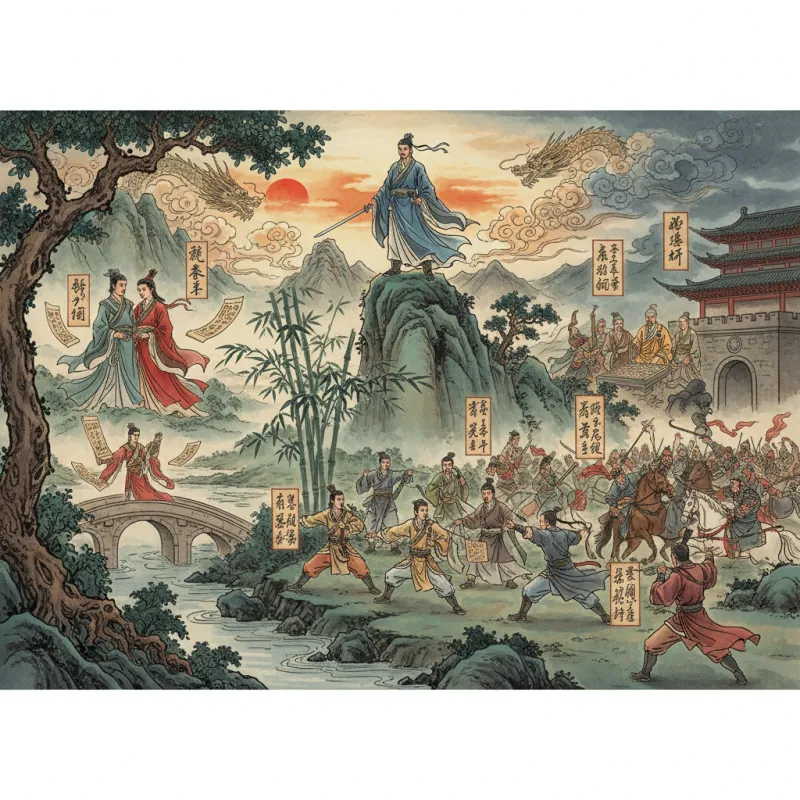
When Xiao Feng discovers he's actually Khitan — the enemy he's spent his life fighting — he doesn't just lose his identity. He loses his entire moral universe. The revelation in Demi-Gods and Semi-Devils (天龙八部 Tiānlóng Bābù) isn't a plot twist; it's a philosophical crisis that Jin Yong (金庸 Jīn Yōng) returns to obsessively across his fourteen novels. Strip away the acrobatic swordplay and elaborate revenge plots, and you'll find the same questions haunting every protagonist: Who am I when my identity is a lie? What do I owe to a society that betrayed me? Can love transcend the barriers that history and politics erect between people?
The Identity Crisis as Narrative Engine
Jin Yong's heroes rarely know who they really are, and this uncertainty drives the entire narrative machinery. Xiao Feng's ethnic revelation is the most dramatic example, but it's hardly unique. Zhang Wuji (张无忌 Zhāng Wújì) in The Heaven Sword and Dragon Saber (倚天屠龙记 Yǐtiān Túlóngji) grows up as the son of outlaws, forever caught between the orthodox martial world and the "demonic" Ming Cult. Wei Xiaobao (韦小宝 Wéi Xiǎobǎo) in The Deer and the Cauldron (鹿鼎记 Lùdǐngjì) is a brothel-born con artist who becomes the Kangxi Emperor's closest confidant — his entire life is performance, identity as improvisation.
The question "Who am I?" becomes even more destabilizing when characters discover their parentage. Yang Guo (杨过 Yáng Guò) in The Return of the Condor Heroes (神雕侠侣 Shéndiāo Xiálǚ) is the son of a traitor, a fact that poisons every relationship he forms. The martial world judges him not for his actions but for his bloodline, forcing him to either accept this inherited shame or forge an identity so powerful it overwrites his father's legacy.
What makes Jin Yong's treatment of identity sophisticated is that he never offers easy resolutions. Xiao Feng doesn't get to choose between being Han or Khitan — he's forced to recognize that both identities are real and irreconcilable. His suicide at the end isn't defeat; it's the only honest response to an impossible situation. Jin Yong understood what modern identity politics sometimes forgets: that multiple identities can be simultaneously true and mutually exclusive.
Loyalty and Betrayal: The Impossible Choice
If identity is Jin Yong's obsession, loyalty (忠 zhōng) is his torture device. Nearly every major character faces a moment where competing loyalties become incompatible, where choosing one allegiance means betraying another. This isn't melodrama — it's Jin Yong's way of exploring how individuals navigate the crushing weight of social obligation.
The classic formulation appears in The Legend of the Condor Heroes (射雕英雄传 Shèdiāo Yīngxióng Zhuàn), where Guo Jing (郭靖 Guō Jìng) must choose between his Mongolian upbringing and his Han Chinese heritage. Raised by Genghis Khan himself, Guo Jing owes everything to the Mongols — his martial arts training, his status, even his betrothal to Huazheng (华筝 Huázhēng). But he's ethnically Han, and the Mongols are preparing to invade Song China. Jin Yong spends the entire novel building toward this impossible choice, and when it comes, there's no clever solution. Guo Jing chooses his ethnicity over his upbringing, but the novel makes clear this is a tragedy, not a triumph.
The loyalty dilemma becomes even more complex in Demi-Gods and Semi-Devils, where Xiao Feng faces not just competing ethnic loyalties but competing moral frameworks. Should he be loyal to the Beggar Clan that raised him, even after they turn on him? To the Song Dynasty that considers him a barbarian? To the Khitan people who are biologically his kin but culturally foreign? Or to some abstract principle of justice that transcends all these categories? Jin Yong's answer is characteristically bleak: there is no right choice, only the choice you can live with.
What distinguishes Jin Yong from lesser martial arts writers is his refusal to valorize blind loyalty. Wei Xiaobao in The Deer and the Cauldron is loyal to no one but himself, and the novel treats this not as villainy but as a kind of wisdom. In a world where every institution demands absolute loyalty while offering only conditional protection, Wei Xiaobao's opportunism is a survival strategy. Jin Yong seems to suggest that in a corrupt system, the person who refuses to be loyal to anything might be the most honest of all.
Love Across Boundaries
Jin Yong's romances are never simple boy-meets-girl stories. They're always complicated by the same forces that complicate identity and loyalty: ethnicity, class, sect affiliation, family history. Love in Jin Yong's world is an act of transgression, a refusal to accept the boundaries that society insists are natural and immutable.
The most famous example is Yang Guo and Xiaolongnü (小龙女 Xiǎolóngnǚ) in The Return of the Condor Heroes, whose relationship violates the master-student taboo. But the ethnic boundary is even more significant. Xiao Feng's love for A'Zhu (阿朱 Āzhū) and later A'Zi (阿紫 Āzǐ) in Demi-Gods and Semi-Devils is doomed not by personality incompatibility but by the Song-Liao conflict. Their personal feelings are irrelevant in the face of historical forces.
What's remarkable is how Jin Yong uses these doomed romances to critique the very concept of ethnic and cultural boundaries. If Xiao Feng and A'Zhu can love each other despite being on opposite sides of a war, doesn't that suggest the war itself is absurd? If Yang Guo and Xiaolongnü's love is genuine despite violating Confucian propriety, doesn't that suggest Confucian propriety is the problem?
Jin Yong's most radical statement on love comes in The Smiling, Proud Wanderer (笑傲江湖 Xiàoào Jiānghú), where Linghu Chong (令狐冲 Línghú Chōng) loves Yue Lingshan (岳灵珊 Yuè Língshān) who loves Lin Pingzhi (林平之 Lín Píngzhī) who loves only revenge. The novel's point isn't that love conquers all — it's that love often conquers nothing, that the most intense feelings can be completely irrelevant to how lives actually unfold. This is Jin Yong at his most unsentimental, refusing to offer the consolations that genre fiction usually provides.
Power and Corruption
Jin Yong's novels are obsessed with power — who has it, how they got it, what it does to them. And his answer is almost always the same: power corrupts, and absolute power corrupts absolutely. This isn't a subtle theme; Jin Yong beats you over the head with it in novel after novel.
The clearest example is The Smiling, Proud Wanderer, which is essentially a 1,000-page meditation on how the pursuit of power destroys everything it touches. Yue Buqun (岳不群 Yuè Bùqún), the "Gentleman Sword," starts as a respected martial arts master and ends as a castrated monster who has murdered his way to the leadership of the Five Mountains Sword Sects Alliance. His transformation isn't sudden — Jin Yong traces it step by step, showing how each compromise leads to the next, how the logic of power accumulation has its own inexorable momentum.
What makes Jin Yong's treatment of power interesting is that he doesn't just condemn the obviously villainous. He's equally suspicious of the "righteous" martial arts sects, showing how their claims to moral authority are usually covers for naked self-interest. The Shaolin Temple in Demi-Gods and Semi-Devils is revealed to be just as capable of murder and betrayal as any demonic cult. The Wudang Sect in The Heaven Sword and Dragon Saber participates in the persecution of Zhang Wuji's parents despite knowing they're innocent.
Jin Yong's most subversive move is making his most morally admirable characters the ones who refuse power entirely. Linghu Chong repeatedly turns down leadership positions, preferring to remain a wandering swordsman. Guo Jing in The Return of the Condor Heroes spends decades defending Xiangyang not because he wants power but because he feels obligated to protect the innocent. The implication is clear: the moment you want power, you've already been corrupted by it.
The Individual vs. Society
Underlying all these themes is a fundamental tension between individual freedom and social obligation, between 江湖 (jiānghú, the martial world) and 庙堂 (miàotáng, the imperial court), between personal desire and collective duty. Jin Yong's heroes are almost always caught between these poles, unable to fully commit to either.
This tension is most explicit in The Deer and the Cauldron, where Wei Xiaobao serves both the Kangxi Emperor and the anti-Qing Heaven and Earth Society. He's loyal to both and neither, constantly improvising his way through impossible situations. The novel's genius is that it never resolves this tension — Wei Xiaobao simply walks away from both sides at the end, choosing personal freedom over any form of social obligation.
But even Jin Yong's more conventionally heroic characters struggle with this dilemma. Guo Jing in The Legend of the Condor Heroes wants nothing more than to live quietly with Huang Rong (黄蓉 Huáng Róng), but his sense of duty to the Han Chinese people keeps pulling him back into conflict. Yang Guo wants only to be with Xiaolongnü, but the martial world won't leave them alone. The message seems to be that in Jin Yong's universe, you can't opt out — society will always make claims on you, whether you accept them or not.
Justice and Revenge
Jin Yong's novels are full of revenge plots, but he's deeply ambivalent about revenge as a moral principle. On one hand, his novels take seriously the Confucian obligation to avenge one's parents and masters. On the other hand, they show how revenge perpetuates cycles of violence that destroy everyone involved.
The Book and the Sword (书剑恩仇录 Shūjiàn Ēnchóulù), Jin Yong's first novel, is essentially about the futility of revenge. The Red Flower Society spends the entire novel plotting revenge against the Qing Dynasty, and by the end they've accomplished nothing except getting most of their members killed. The novel doesn't celebrate their sacrifice — it mourns it.
The most complex treatment of revenge comes in The Heaven Sword and Dragon Saber, where multiple revenge plots intersect and cancel each other out. Zhang Wuji's parents are destroyed by revenge-seekers, making Zhang Wuji himself an object of revenge, which leads to more revenge, in an endless cycle. Jin Yong's point is that revenge doesn't restore justice — it just creates more injustice, more grievances, more reasons for future revenge.
Yet Jin Yong never quite condemns revenge either. When Xiao Feng discovers who killed his parents in Demi-Gods and Semi-Devils, the novel treats his desire for revenge as legitimate, even if it ultimately proves misguided. Jin Yong seems to understand that revenge is a natural human impulse, even if it's also a destructive one. His novels don't offer easy answers — they just show the consequences and let readers judge for themselves.
The Limits of Martial Arts
Finally, there's a meta-theme running through all of Jin Yong's work: martial arts themselves are ultimately inadequate to solve the problems that matter. His heroes can split mountains and redirect rivers with their internal energy, but they can't resolve ethnic conflicts, prevent wars, or escape the constraints of history.
This is most obvious in Demi-Gods and Semi-Devils, where the three protagonists — Xiao Feng, Duan Yu (段誉 Duàn Yù), and Xu Zhu (虚竹 Xū Zhú) — all achieve extraordinary martial arts mastery, and it solves exactly none of their problems. Xiao Feng's kung fu can't make him Han or Khitan, can't prevent the Song-Liao war, can't bring back A'Zhu. Duan Yu's abilities don't help him win Wang Yuyan's (王语嫣 Wáng Yǔyān) love. Xu Zhu's power doesn't make him any less confused about his place in the world.
Jin Yong's final novel, The Deer and the Cauldron, takes this theme to its logical conclusion by making the protagonist almost completely incompetent at martial arts. Wei Xiaobao succeeds not through kung fu but through cunning, luck, and shamelessness. The novel seems to suggest that in the real world — the world of politics and power — martial arts are largely irrelevant. What matters is understanding human nature, reading situations correctly, and knowing when to run away.
This is why Jin Yong's novels transcend their genre. They use martial arts as a metaphor for exploring deeper questions about identity, loyalty, love, power, and justice. The sword fights are spectacular, but they're not the point. The point is what happens when the fighting stops, when characters have to figure out how to live in a world that offers no clear answers, only impossible choices. That's the real theme of Jin Yong's work: the struggle to maintain humanity and integrity in a world that constantly demands you compromise both.
Related Reading
- Gu Long vs. Jin Yong: The Great Wuxia Debate
- The Literary Depth of Jin Yong's Martial Arts Fiction
- Jin Yong Reading Order Guide: Where to Start
- Jin Yong: The Man Behind the Martial Arts World
- Love and Sacrifice in Jin Yong's World
- Exploring the Intricate Sects within Jin Yong's Iconic Wuxia Novels
- How the Condor Trilogy Connects: Characters, Weapons, and Secrets Across 155 Years