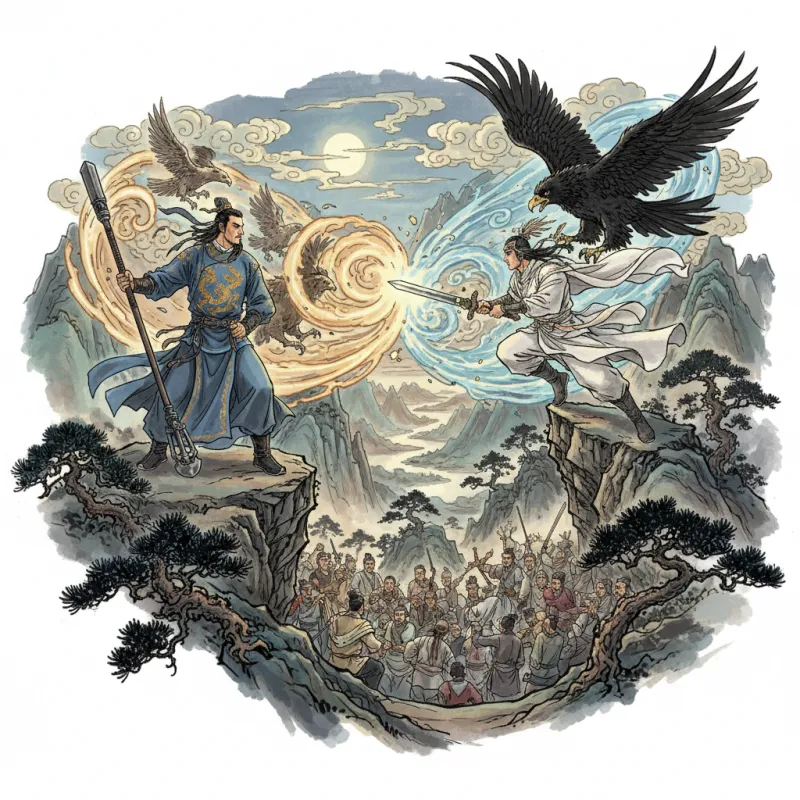
Who would win in a fight: Guo Jing or Yang Guo? It's a question that's sparked more heated arguments in Chinese teahouses, internet forums, and family gatherings than perhaps any other literary debate of the past seventy years. And it's just one of many Jin Yong controversies that refuse to die. These aren't polite academic discussions — they're passionate, evidence-laden battles where fans quote chapter and verse, construct elaborate power-scaling charts, and occasionally accuse each other of having read entirely different novels.
The remarkable thing? Some of these debates have been running continuously since the 1950s, passed down like heirlooms from one generation of readers to the next. New readers inevitably take sides, add their own arguments, and keep the fires burning. Jin Yong himself occasionally weighed in, but even authorial pronouncements couldn't settle these disputes. The fandom simply absorbed his comments as additional evidence and kept arguing.
The Eternal Triangle: Huang Rong vs. Zhao Min vs. Ren Yingying
This isn't just a debate — it's a three-way cold war that's been running since the 1960s. Huang Rong (黄蓉, Huáng Róng) from The Legend of the Condor Heroes, Zhao Min (赵敏, Zhào Mǐn) from The Heaven Sword and Dragon Saber, and Ren Yingying (任盈盈, Rén Yíngyíng) from The Smiling, Proud Wanderer represent three distinct archetypes of the Jin Yong heroine, and fans have been arguing about which one represents the ideal for over half a century.
The Huang Rong faction argues for her as the original and best: brilliant, playful, fiercely loyal, and capable of both tenderness and ruthlessness. She's the daughter of Peach Blossom Island's master, raised with encyclopedic knowledge and unconventional thinking. Her supporters point to how she transforms from a mischievous girl into the formidable leader of the Beggars' Sect, all while maintaining her essential character. The criticism? She's manipulative, occasionally cruel to those outside her circle, and her intelligence sometimes manifests as scheming rather than wisdom.
Zhao Min's defenders counter that she's everything Huang Rong is, but with added complexity. She starts as an antagonist — a Mongol princess working against the Han Chinese martial arts world — and her love for Zhang Wuji leads her to betray her own people. That's dramatic character development, they argue, not just character consistency. She's bold, direct, and willing to sacrifice everything for love. The opposing view? She's too impulsive, her betrayal of her heritage is troubling, and her relationship with Zhang Wuji involves too much manipulation and forced situations.
Then there's the Ren Yingying camp, who argue that she represents a more mature, nuanced ideal. She's powerful in her own right as the Holy Maiden of the Sun Moon Holy Cult, but she doesn't need to prove it constantly. She supports Linghu Chong without controlling him, understands his need for freedom, and accepts his flaws. Her critics say she's too passive, too willing to accommodate, and lacks the fire of the other two.
The debate has evolved over decades. In the 1960s and 1970s, it was mostly about personality and loyalty. In the 1980s and 1990s, feminist readings emerged, examining how each character navigates patriarchal structures. In the 2000s and beyond, discussions incorporated modern relationship dynamics and emotional intelligence. Each generation finds new angles, new evidence, new reasons why their favorite is superior.
The Power Scaling Wars: Who's Actually the Strongest?
If you want to start a fight in any Jin Yong fan community, just ask: "Who would win — Dugu Qiubai (独孤求败, Dúgū Qiúbài) or Sweeping Monk (扫地僧, Sǎodì Sēng)?" Then step back and watch the chaos unfold.
The problem is that Jin Yong's novels span different eras and different power levels. The martial artists in Demi-Gods and Semi-Devils (set in the Song dynasty) seem generally more powerful than those in The Deer and the Cauldron (set in the Qing dynasty). But how do you compare characters who never meet? How do you rank someone like Dugu Qiubai, who only appears through reputation and flashbacks?
The Sweeping Monk faction argues he's clearly the strongest character in the entire Jin Yong universe. He appears in Demi-Gods and Semi-Devils as an unnamed monk sweeping floors in Shaolin Temple's scripture repository, then casually demonstrates martial arts so advanced that he makes the novel's other top fighters look like children. He understands the fundamental principles underlying all martial arts, can heal injuries with internal energy, and seems to have transcended normal human limitations. Case closed, right?
Not so fast, say the Dugu Qiubai supporters. Dugu Qiubai's reputation in The Return of the Condor Heroes and The Smiling, Proud Wanderer suggests someone who surpassed all opponents in his era and eventually found swordsmanship itself limiting. His progression through four stages — sharp sword, soft sword, heavy sword, and finally no sword — represents a philosophical journey beyond mere technique. The fact that we never see him fight is precisely the point: he's beyond demonstration, beyond comparison.
Then there's the Zhang Sanfeng (张三丰, Zhāng Sānfēng) contingency, arguing that the founder of Wudang and creator of Taiji principles deserves consideration. And the Xiaoyao Sect (逍遥派, Xiāoyáo Pài) supporters who point to the ancient, esoteric martial arts in Demi-Gods and Semi-Devils. And the contrarians who argue that Wang Chongyang (王重阳, Wáng Chóngyáng), winner of the first Mount Hua tournament, should rank higher than anyone gives him credit for.
The debates involve detailed textual analysis, mathematical calculations of internal energy cultivation rates, and elaborate tournament brackets. Fans create tier lists, power scaling charts, and hypothetical matchup analyses. Jin Yong himself said in interviews that he didn't think too carefully about cross-novel power comparisons, but that admission only fueled more debate. If the author didn't establish clear rules, fans would create their own.
The Zhang Wuji Problem: Worst Protagonist or Misunderstood Hero?
No Jin Yong protagonist divides opinion quite like Zhang Wuji (张无忌, Zhāng Wújì) from The Heaven Sword and Dragon Saber. He's either a frustratingly indecisive character who stumbles through the plot, or a realistically flawed hero whose struggles with choice and responsibility make him the most human of Jin Yong's protagonists. There's very little middle ground.
The anti-Zhang Wuji faction has a long list of grievances. He's indecisive to the point of paralysis, unable to choose between four women who all love him. He's passive, with most of his power and position coming from accidents and other people's efforts rather than his own initiative. He becomes leader of the Ming Cult almost by default, wields the Heaven Reliant Sword without earning it, and masters the Nine Yang Divine Skill because he happened to be trapped in a cave with the manual. Even his final choice of Zhou Zhiruo over Zhao Min (or is it Zhao Min over Zhou Zhiruo? The ending is deliberately ambiguous) feels less like a decision and more like exhausted resignation.
His defenders argue that this is precisely what makes him interesting. Unlike Guo Jing's straightforward righteousness or Linghu Chong's carefree wanderer persona, Zhang Wuji is someone genuinely torn between competing goods. He doesn't want to hurt anyone, which is admirable even if it's impossible. His indecisiveness reflects real moral complexity — the women in his life aren't simple choices between good and evil, but different people he genuinely cares about in different ways. His reluctance to lead reflects humility, not weakness. And his "accidental" achievements still require him to survive, adapt, and ultimately take responsibility.
The debate intensified after Jin Yong's revisions to the novel. In different editions, Zhang Wuji's character and the ending's ambiguity shifted slightly, giving both sides new ammunition. Television and film adaptations have also influenced the debate, with some versions making Zhang Wuji more decisive and others leaning into his passivity.
What makes this debate particularly interesting is how it reflects changing cultural attitudes toward masculinity and heroism. In the 1960s, Zhang Wuji's indecisiveness was almost universally criticized. By the 1990s and 2000s, some readers began appreciating his emotional complexity. The debate isn't just about one character — it's about what we want from our heroes.
The Linghu Chong Drinking Problem: Alcoholism or Artistic License?
Here's a debate that emerged gradually and says a lot about how Jin Yong fandom has matured. Linghu Chong (令狐冲, Línghú Chōng), the protagonist of The Smiling, Proud Wanderer, drinks constantly throughout the novel. He drinks when he's happy, when he's sad, when he's injured, when he's celebrating, when he's mourning. He drinks so much that it becomes a defining character trait.
For decades, this was simply accepted as part of his carefree, wanderer persona. He's a jianghu (江湖, jiānghú) swordsman who lives by his own rules, and drinking is part of that lifestyle. The novel treats his drinking romantically — he bonds with friends over wine, has important conversations while drunk, and even develops a friendship with the "wine-loving" monk Bujie.
But starting in the 2000s, some fans began asking uncomfortable questions. Does Linghu Chong have a drinking problem? Is his alcohol consumption actually a form of self-medication for trauma and depression? The novel mentions that he's often injured and in pain — is he drinking to cope? His relationship with Yue Lingshan ends badly, he's expelled from his sect, he faces repeated near-death experiences. His drinking intensifies during his lowest points.
The traditional reading pushes back hard. This is a wuxia novel set in a pseudo-historical China where different rules apply. Alcohol in Jin Yong's world isn't the same as alcohol in reality — it's almost a magical substance that enhances martial arts, facilitates friendship, and represents freedom from social constraints. Analyzing Linghu Chong through the lens of modern addiction medicine misses the point entirely. It's like criticizing The Lord of the Rings for not addressing the Shire's agricultural sustainability.
The modern reading counters that Jin Yong's novels have always rewarded close psychological analysis. His characters aren't simple archetypes — they're complex people with realistic emotional lives. Linghu Chong's drinking patterns, his depression, his difficulty connecting with others except through alcohol, all suggest something deeper than just "carefree wanderer enjoys wine." The novel can be both a romantic wuxia adventure and a portrait of someone struggling with trauma.
This debate connects to broader discussions about how we read older literature and whether applying modern frameworks is illuminating or anachronistic. It's also one of the few debates where both sides occasionally admit the other has valid points, even if they disagree on emphasis.
Guo Jing vs. Yang Guo: The Original Versus the Remix
This is where we started, and it's the debate that's been running longest — since The Return of the Condor Heroes was first serialized in 1959, just a few years after The Legend of the Condor Heroes concluded. Jin Yong deliberately created Yang Guo (杨过, Yáng Guò) as a contrast to his father figure Guo Jing (郭靖, Guō Jìng), and fans have been arguing about which approach to heroism is superior ever since.
Guo Jing is the straightforward hero: loyal, righteous, somewhat slow-witted but determined, devoted to protecting the common people. He's the Confucian ideal of the junzi (君子, jūnzǐ) — the superior person who cultivates virtue and serves society. His martial arts journey involves hard work and persistence rather than natural talent. By the end of his story, he's defending Xiangyang against the Mongol invasion, literally standing as the shield between civilization and chaos.
Yang Guo is everything Guo Jing isn't: clever, rebellious, emotionally complex, willing to question authority and tradition. He falls in love with his teacher, which violates fundamental social taboos. He's naturally talented but struggles with emotional regulation and revenge fantasies. He's the Daoist ideal of the zhenren (真人, zhēnrén) — the authentic person who follows their own nature rather than social expectations. His heroism is more individualistic, more ambiguous, more modern.
The Guo Jing faction argues that he represents timeless virtues: duty, loyalty, self-sacrifice, protection of the weak. His simplicity is actually wisdom — he understands what matters and doesn't get distracted by cleverness or self-interest. His relationship with Huang Rong is healthy and equal, unlike Yang Guo's obsessive attachment to Xiaolongnü. And his legacy — defending Xiangyang, raising his daughters, leading the martial arts world — demonstrates that traditional heroism works.
The Yang Guo faction counters that he's the more interesting, more realistic character. Real people are conflicted, make mistakes, struggle with inappropriate feelings, and don't always fit social expectations. Yang Guo's journey toward maturity and his ultimate heroism at the Battle of Xiangyang are more meaningful because he had further to travel. His love for Xiaolongnü, while unconventional, is genuine and deep. And his willingness to question authority and forge his own path makes him more relevant to modern readers.
The debate has spawned countless sub-debates: Who's the better martial artist? Who had the harder journey? Whose relationship is healthier? Who would win in a fight? (That last one connects back to the power scaling wars, of course.) Jin Yong himself seemed to favor Yang Guo slightly, calling him his most complex protagonist, but that hasn't settled anything.
Wei Xiaobao: Satire or Celebration?
The Deer and the Cauldron is Jin Yong's final and most controversial novel, and its protagonist Wei Xiaobao (韦小宝, Wéi Xiǎobǎo) is the most controversial character. He's a barely literate, amoral trickster who lies, cheats, steals, and manipulates his way to success. He has no martial arts skills. He's loyal to friends but has no broader principles. He serves both the Qing emperor and the anti-Qing resistance, playing both sides for personal advantage.
The question that's divided fans since 1972: Is Wei Xiaobao a satirical critique of traditional heroism and Chinese society, or is he a celebration of pragmatic survival and human nature's complexity? Is Jin Yong saying that traditional heroes are unrealistic and Wei Xiaobao represents how people actually succeed? Or is he showing us what happens when society loses its moral center?
The satire reading argues that The Deer and the Cauldron is Jin Yong's most mature work, a deliberate deconstruction of the wuxia genre he spent decades building. Wei Xiaobao succeeds where traditional heroes would fail precisely because he's not bound by honor, righteousness, or martial codes. He survives the treacherous Qing court through flexibility and cunning. The novel suggests that in corrupt times, traditional heroism is not just ineffective but dangerous. It's a dark, cynical view, but it's also sophisticated and realistic.
The celebration reading sees Wei Xiaobao as a folk hero in the trickster tradition, someone who uses wit to overcome power. He's loyal to friends, kind to those who help him, and ultimately chooses freedom over power by retiring with his seven wives. Yes, he's amoral by conventional standards, but he's also honest about it — unlike the supposedly righteous characters who hide their self-interest behind noble rhetoric. He represents a different kind of wisdom: adaptability, humor, and the ability to find joy in an imperfect world.
A third faction argues that the novel is deliberately ambiguous, presenting Wei Xiaobao without clear judgment and letting readers decide. This interpretation sees The Deer and the Cauldron as Jin Yong's most open-ended work, a novel that trusts readers to grapple with moral complexity rather than providing clear answers.
This debate has intensified in recent decades as China has modernized and questions about traditional values versus pragmatic success have become more urgent. Wei Xiaobao means something different to readers in 1972, 1997, and 2024. The debate isn't just about one character — it's about what kind of society we want and what kind of success we value.
Why These Debates Never End
The remarkable thing about Jin Yong debates isn't that they exist — any popular work generates fan discussions. It's that they persist across generations with undiminished intensity. Readers in their seventies who first encountered these novels in newspaper serializations argue with teenagers discovering them through online forums, and neither side has any intention of conceding.
Part of this is the richness of Jin Yong's work. His novels reward close reading and re-reading. They contain enough complexity, ambiguity, and psychological depth to support multiple interpretations. Unlike some popular fiction that reveals all its secrets on first reading, Jin Yong's novels keep offering new insights.
Part of it is cultural significance. These novels aren't just entertainment — they're part of Chinese cultural identity, comparable to Shakespeare in English-speaking cultures or Goethe in German-speaking ones. Debating them is a way of debating values, history, and identity. When fans argue about whether Guo Jing or Yang Guo represents better heroism, they're really arguing about what kind of person they want to be and what kind of society they want to live in.
And part of it is simply that Jin Yong created characters vivid enough to feel real. When you care deeply about characters, you want to defend them, analyze them, argue about them. The debates continue because the characters matter.
Jin Yong passed away in 2018, but the debates he sparked show no signs of ending. New readers discover the novels, take sides, and add their voices to arguments that have been running for half a century. The debates have become part of the novels' legacy, a living tradition of engagement and interpretation. And honestly? That's exactly how it should be. Literature that generates passionate, decades-long debates is literature that matters.
For more on how fans interpret Jin Yong's work, see The Most Controversial Character Interpretations and Analyzing Jin Yong's Moral Philosophy.
Related Reading
- The Biggest Unsolved Mysteries in Jin Yong Novels
- Jin Yong's Fan Theories: The Debates That Never End
- Hidden Connections Between Jin Yong Novels
- Alternative Endings Fans Wish Jin Yong Had Written
- The Martial Arts Ranking Debate: Who Is Actually the Strongest in Jin Yong?
- Demi-Gods and Semi-Devils: A Complete Guide
- The Couples of Jin Yong: Love Stories Hidden Inside Martial Arts Epics