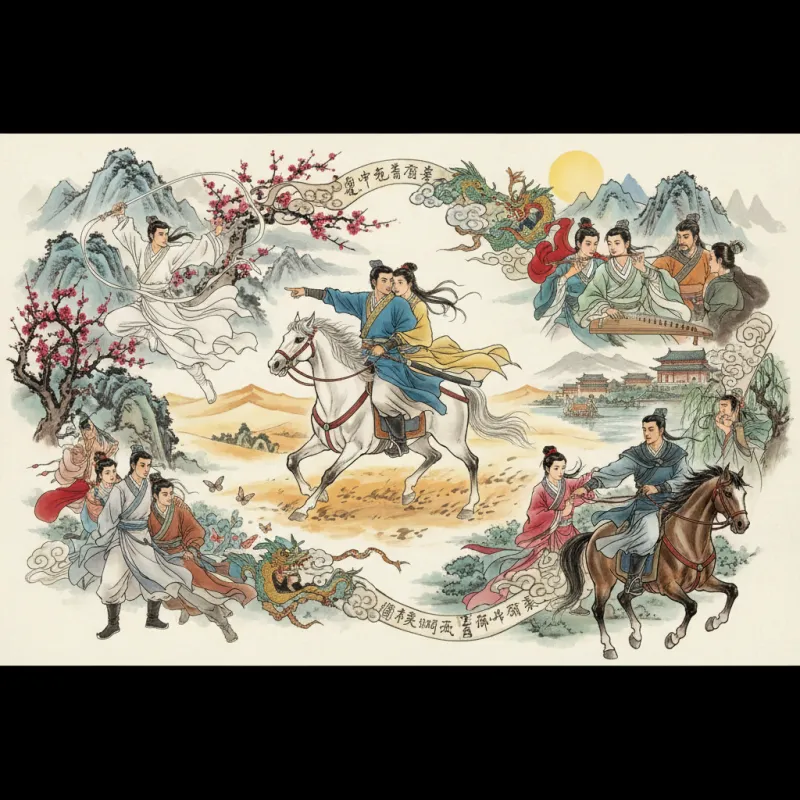
When Guo Jing first meets Huang Rong in The Legend of the Condor Heroes (射雕英雄传, Shèdiāo Yīngxióng Zhuàn), he thinks she's a beggar boy. She's actually the daughter of one of the most brilliant martial artists in the world, testing him. This moment of disguise and revelation sets the template for every Jin Yong romance that follows: love arrives wearing a mask, and the real story is what happens when the masks come off.
The Architecture of Jin Yong's Romance
Jin Yong wrote fifteen novels between 1955 and 1972. Every single one contains a central romantic relationship. Yet he's rarely discussed as a romance writer—the martial arts, the historical sweep, the philosophical depth tend to dominate critical attention. This is a mistake. The love stories aren't decoration. They're the emotional engine that makes everything else matter.
What distinguishes Jin Yong's approach is that his couples never get easy happiness. Love in his novels is always complicated by identity (you're from the enemy clan), duty (I must avenge my father by killing yours), or impossible circumstance (you're my martial arts master and I'm your student). The obstacles aren't arbitrary—they emerge organically from the wuxia world itself, where loyalty, honor, and revenge create webs of obligation that trap even the most devoted lovers.
Guo Jing and Huang Rong: Complementary Opposites
The template couple. He's honest to the point of stupidity, physically powerful, morally rigid. She's brilliant, manipulative, emotionally sophisticated. On paper, they're incompatible. In practice, they're Jin Yong's most successful marriage.
What makes them work is that Jin Yong understood complementarity isn't about similarity—it's about completing each other's deficiencies. Guo Jing provides the moral compass that prevents Huang Rong's cleverness from curdling into cynicism. Huang Rong provides the strategic intelligence that turns Guo Jing's brute strength into effective action. Neither could achieve what they do alone.
Their relationship also establishes Jin Yong's pattern of the woman being smarter than the man. Huang Rong is always three steps ahead of Guo Jing intellectually, yet she chooses him anyway—not despite his simplicity, but because of the moral clarity it represents. In a world of deception and political maneuvering, Guo Jing's inability to lie becomes a form of strength.
Yang Guo and Xiaolongnü: Love Against the World
If Guo Jing and Huang Rong represent complementary partnership, Yang Guo (杨过) and Xiaolongnü (小龙女) in The Return of the Condor Heroes represent love as defiance. Their relationship violates the fundamental taboo of the wuxia world: she's his martial arts master, making their romance a betrayal of the teacher-student hierarchy that structures the entire genre.
Jin Yong makes this transgression the point. Yang Guo and Xiaolongnü's love exists in opposition to social norms, and their sixteen-year separation becomes a test of whether personal devotion can survive societal condemnation. The answer—yes, but at tremendous cost—makes their reunion one of the most emotionally devastating moments in Chinese popular fiction.
What's often overlooked is how Jin Yong uses their age gap (she's several years older) to quietly subvert gender expectations. Xiaolongnü is emotionally detached, almost alien in her inability to understand normal human relationships. Yang Guo is the emotional one, the one who pursues, who suffers, who waits. Jin Yong reverses the typical gender dynamics without making a show of it.
Linghu Chong and Ren Yingying: The Meeting of Equals
In The Smiling, Proud Wanderer (笑傲江湖, Xiào'ào Jiānghú), Jin Yong creates his most mature romantic relationship. Linghu Chong (令狐冲) and Ren Yingying (任盈盈) are both highly skilled martial artists, both politically sophisticated, both capable of independent action. Their relationship isn't about complementarity or defiance—it's about two complete individuals choosing partnership.
What makes them compelling is that Ren Yingying doesn't need rescuing. She's the daughter of the Sun Moon Holy Cult's leader, commands her own forces, and is perfectly capable of solving her own problems. When she helps Linghu Chong, it's not because he's helpless—it's because she's chosen him as her equal. This is Jin Yong's most feminist couple, though he'd probably never use that term.
The contrast with Linghu Chong's earlier infatuation with his martial sister Yue Lingshan (岳灵珊) is instructive. Yue Lingshan represents the unattainable ideal, the pure first love that can never be. Ren Yingying represents the real relationship, built on mutual respect and shared values rather than idealization. Jin Yong is clear about which matters more.
The Tragic Couples: When Love Isn't Enough
Not all of Jin Yong's couples succeed. Some of his most memorable relationships are the ones that fail—and fail specifically because love alone can't overcome the structural forces arrayed against them.
Qiao Feng (乔峰) and A'Zhu (阿朱) in Demi-Gods and Semi-Devils (天龙八部, Tiānlóng Bābù) represent love destroyed by mistaken identity and revenge. A'Zhu dies by Qiao Feng's own hand in a case of tragic misrecognition, and Qiao Feng spends the rest of the novel trying to atone for a mistake that can never be undone. Their relationship asks: what happens when the person you love most becomes the person you've harmed most?
Similarly, the multiple failed relationships in The Deer and the Cauldron (鹿鼎记, Lùdǐng Jì)—where Wei Xiaobao (韦小宝) ends up with seven wives—represent Jin Yong's most cynical take on romance. Wei Xiaobao doesn't have deep emotional connections; he has transactional relationships based on mutual benefit. It's telling that this, Jin Yong's final novel, treats romance as comedy rather than tragedy or triumph.
The Pattern: Love as Character Development
What unifies Jin Yong's diverse approaches to romance is that love always serves character development. His protagonists don't fall in love and remain static—they're transformed by the experience. Guo Jing becomes more flexible through Huang Rong's influence. Yang Guo's obsessive devotion to Xiaolongnü shapes his entire personality. Linghu Chong's relationship with Ren Yingying forces him to engage with political realities he'd rather avoid.
This is why the love stories matter as much as the martial arts. The kung fu sequences show us what the characters can do. The romantic relationships show us who they are. And in Jin Yong's moral universe, who you are matters more than what you can do.
The couples also serve as Jin Yong's vehicle for exploring different models of partnership. He's not prescriptive—he doesn't suggest there's one right way to love. Instead, he presents multiple models: complementary opposites, defiant lovers, equal partners, tragic mismatches. Each works or fails based on the specific circumstances and personalities involved.
Why These Couples Endure
Jin Yong's couples have remained in Chinese popular consciousness for decades because they feel psychologically real despite the fantastical settings. The obstacles they face—family opposition, identity conflicts, duty versus desire—are universal human experiences, even if they're expressed through wuxia conventions.
More importantly, Jin Yong never treats his female characters as prizes to be won. Huang Rong, Xiaolongnü, Ren Yingying—they're all fully realized characters with their own goals, skills, and agency. They choose their partners; they're not awarded to them. This respect for female autonomy, unusual in 1960s popular fiction, is part of why these relationships still resonate.
The love stories also benefit from Jin Yong's willingness to let them be complicated. His couples argue, misunderstand each other, make mistakes. Guo Jing and Huang Rong have a genuinely difficult period in The Return of the Condor Heroes when they disagree about Yang Guo. Linghu Chong's lingering feelings for Yue Lingshan create real tension with Ren Yingying. These aren't perfect relationships—they're real ones, with all the messiness that implies.
The Subtext Becomes Text
Jin Yong is remembered for revolutionizing the wuxia genre, for creating complex moral universes, for writing martial arts sequences that read like poetry. But perhaps his most lasting achievement is proving that genre fiction can contain genuine emotional depth. The martial arts are spectacular, but the love stories are what make us care.
When readers return to these novels decades later, they often find that the fight scenes blur together, but the romantic moments remain vivid. Huang Rong cooking for Guo Jing. Yang Guo waiting sixteen years at the bottom of a valley. Ren Yingying playing the guqin while Linghu Chong recovers from his injuries. These are the scenes that linger, the ones that transform martial arts epics into something more.
The couples of Jin Yong remind us that even in a world of superhuman kung fu masters and legendary weapons, the most powerful force is still the choice to love someone despite all the reasons not to. That's not subtext. That's the whole point.
Related Reading
- The Couples of Jin Yong: Love Stories That Defined Chinese Romance
- The Most Tragic Love Stories in Jin Yong's Novels
- Love Triangles in Jin Yong: When Heroes Can't Choose
- The 10 Best Couples in Jin Yong's Novels
- Exploring the Enigmatic Worlds of Jin Yong's Wuxia Novels
- The Nine Yin Manual: Most Coveted Martial Arts Text
- The Enigmatic Hidden Techniques in Jin Yong’s Wuxia Novels Explored