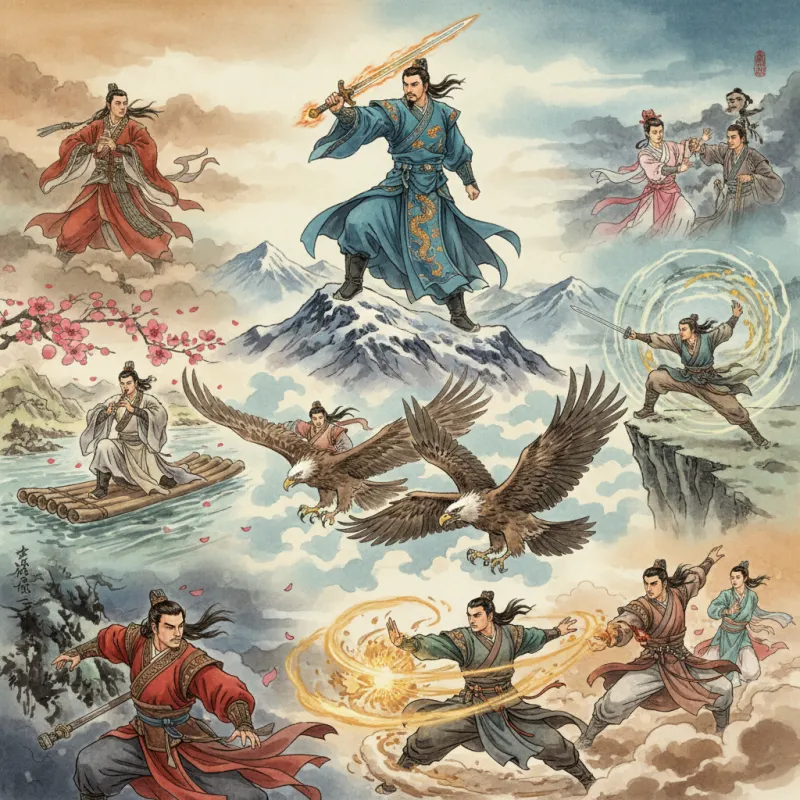
The 1983 TVB production of The Legend of the Condor Heroes (射雕英雄传 Shèdiāo Yīngxióng Zhuàn) opens with a shot that changed everything: Felix Wong Yat-wa as Guo Jing, standing on the Mongolian steppes, bow in hand, wind whipping his simple robes. No CGI. No wire work that looks like a video game. Just an actor embodying a character so completely that three generations of viewers still can't separate the two. That's the power of a perfect adaptation — it doesn't just visualize the novel, it becomes the definitive version in the cultural imagination.
Jin Yong's (金庸 Jīn Yōng) fourteen novels have spawned over 100 television adaptations since the 1970s. Some are masterpieces that honor the source material while adding cinematic brilliance. Others are so bad they make you wonder if the producers actually read the books, or just skimmed a plot summary on the back of a pirated DVD. The difference between the best and worst isn't just production value or star power — it's understanding what makes Jin Yong's storytelling work in the first place.
What Makes a Jin Yong Adaptation Actually Work
Here's the thing about adapting Jin Yong: his novels are long, dense, and structurally complex. The Deer and the Cauldron (鹿鼎记 Lùdǐng Jì) runs over 1,200 pages. Demi-Gods and Semi-Devils (天龙八部 Tiānlóng Bābù) juggles three protagonists and dozens of subplots across multiple kingdoms. You can't just film the book — you have to understand its rhythm, its themes, and what Jin Yong was actually saying beneath all the sword fights.
The best adaptations nail three things: casting that captures character essence rather than just physical beauty, pacing that respects the novel's structure, and fight choreography that serves the story instead of showing off. The worst adaptations get seduced by spectacle, cast idols who can't act, and gut the philosophical depth that makes Jin Yong literature rather than just pulp.
Television, not film, is Jin Yong's natural medium. A 40-50 episode series can accommodate his sprawling narratives, his slow-burn character development, his digressions into history and philosophy. Films have to compress and simplify, which usually means losing what makes the novels special. That's why the iconic adaptations are almost all TV series, and why they matter so much to how readers understand the source material.
The 1983 TVB Legend of the Condor Heroes: The One That Set the Standard
This is the adaptation all others are measured against. Director Wang Tianlin understood something crucial: Guo Jing's journey from naive Mongolian boy to righteous hero only works if you believe in his fundamental decency. Felix Wong wasn't the most handsome actor TVB could have cast, but he had something better — an earnest quality that made Guo Jing's moral simplicity feel genuine rather than stupid.
Barbara Yung Mei-ling as Huang Rong (黄蓉 Huáng Róng) was equally perfect casting. She played the character's intelligence and mischief without making her seem calculating or cold. The chemistry between Wong and Yung carried the series, but the supporting cast was just as strong. Lau Dan's Hong Qigong (洪七公 Hóng Qīgōng) was jovial without being cartoonish. Yeung Chak-lam's Ouyang Feng (欧阳锋 Ōuyáng Fēng) was menacing without chewing scenery.
The fight choreography, supervised by Tang Jik-ming, prioritized clarity and character over flash. When Guo Jing learns the Eighteen Dragon-Subduing Palms (降龙十八掌 Jiàng Lóng Shíbā Zhǎng), you see his progress through specific techniques, not just increasingly elaborate wire work. The final confrontation at Peach Blossom Island (桃花岛 Táohuā Dǎo) feels earned because we've watched these characters develop for 59 episodes.
This adaptation also understood Jin Yong's historical backdrop. The Mongol invasion isn't just set dressing — it's the moral framework for Guo Jing's choices. The series takes time to show the complexity of loyalty and patriotism in a time of conquest, which gives weight to Guo Jing's eventual decision to defend Xiangyang. That thematic depth is what separates great adaptations from merely competent ones.
The 1997 TVB Demi-Gods and Semi-Devils: Juggling Three Heroes
Adapting Demi-Gods and Semi-Devils is like juggling chainsaws while riding a unicycle. The novel follows three protagonists — Duan Yu (段誉 Duàn Yù), Xuzhu (虚竹 Xūzhú), and Qiao Feng (乔峰 Qiáo Fēng) — whose stories only intersect occasionally. Most adaptations either favor one character or create artificial connections that feel forced.
The 1997 TVB version, starring Huang Rihua, Chen Hao-min, and Felix Wong, solved this by treating each storyline with equal weight and trusting the audience to follow multiple threads. Huang Rihua's Qiao Feng is the standout — a tragic hero whose discovery of his Khitan heritage destroys everything he's built. The scene where he confronts the Beggar Clan (丐帮 Gàibāng) after learning the truth is devastating because Huang plays it with quiet dignity rather than melodrama.
Chen Hao-min's Duan Yu could have been insufferable — the character is essentially a pacifist playboy who stumbles into martial arts mastery — but Chen found the humor and humanity in him. His pursuit of Wang Yuyan (王语嫣 Wáng Yǔyān) is obsessive but somehow endearing, and his relationship with his sworn brothers feels genuine.
The series also handled Jin Yong's Buddhist themes better than most adaptations. Xuzhu's journey from naive monk to Vulture Palace (灵鹫宫 Língjiù Gōng) master explores questions about fate, desire, and identity that could easily become preachy. The 1997 version lets these themes emerge naturally through character rather than exposition.
The 1998 Taiwanese The Return of the Condor Heroes: Controversial but Compelling
Casting Louis Koo and Carman Lee in the 1995 TVB version of The Return of the Condor Heroes (神雕侠侣 Shéndiāo Xiálǚ) was brilliant, but the 1998 Taiwanese version with Vincent Chiao and Athena Chu deserves recognition for taking risks. This adaptation leaned into the novel's darker elements — the twisted relationship between Yang Guo (杨过 Yáng Guò) and his aunt Xiaolongnü (小龙女 Xiǎolóngnǚ), the moral ambiguity of characters like Li Mochou (李莫愁 Lǐ Mòchóu), the genuine tragedy of the sixteen-year separation.
Vincent Chiao played Yang Guo as genuinely damaged rather than just rebellious. His Yang Guo is angry, manipulative, and self-destructive — which is actually faithful to the novel's characterization. Jin Yong wrote Yang Guo as someone shaped by abandonment and betrayal, and Chiao didn't soften that. The result is less romantic but more psychologically complex.
The series also gave Li Mochou, played by Fan Wenfang, real depth. She's not just a villain — she's a woman destroyed by love and betrayal who becomes a monster. Her final scene, dying while humming the song that represents her lost love, is genuinely moving. That's the kind of character work that elevates an adaptation beyond simple hero-villain dynamics.
The 2001 TVB The Smiling, Proud Wanderer: Deric Wan's Definitive Linghu Chong
The Smiling, Proud Wanderer (笑傲江湖 Xiào'ào Jiānghú) is Jin Yong's most philosophical novel, a meditation on freedom, orthodoxy, and the corruption of power. It's also notoriously difficult to adapt because the protagonist, Linghu Chong (令狐冲 Línghú Chōng), is essentially passive — things happen to him rather than him driving the plot.
The 2001 TVB version with Deric Wan understood that Linghu Chong's passivity is the point. He's a Daoist hero in a Confucian world, someone who refuses to play the power games that consume everyone around him. Deric Wan played him with a lightness that never became frivolity — he's carefree but not careless, drunk but not foolish.
The series also nailed the novel's critique of martial arts orthodoxy. The conflict between the orthodox sects and the Sun Moon Holy Cult (日月神教 Rìyuè Shénjiào) isn't about good versus evil — it's about different forms of authoritarianism. The "righteous" sects are just as ruthless and hypocritical as the "demonic" cult. That moral complexity comes through clearly in this adaptation, particularly in the character of Yue Buqun (岳不群 Yuè Bùqún), whose transformation from respected master to power-mad villain is chillingly gradual.
The 2003 Mainland The Heaven Sword and Dragon Saber: Epic Scale, Mixed Results
The 2003 mainland Chinese adaptation of The Heaven Sword and Dragon Saber (倚天屠龙记 Yǐtiān Túlóng Jì) starring Alec Su and Alyssa Chia had everything going for it: big budget, experienced cast, gorgeous locations. The result is visually stunning but narratively uneven.
The series excels at spectacle. The battles between the six major sects and Ming Cult (明教 Míngjiào) at Bright Peak (光明顶 Guāngmíng Dǐng) are genuinely epic. The production design for places like Ice Fire Island (冰火岛 Bīnghuǒ Dǎo) and the Ming Cult headquarters is impressive. But the pacing drags in the middle episodes, and some character arcs get shortchanged.
Alec Su's Zhang Wuji (张无忌 Zhāng Wújì) is too passive even for a character defined by indecisiveness. The novel's Zhang Wuji is paralyzed by his inability to choose between four women who love him, but Su plays him as simply weak. The romance between Zhang Wuji and Zhao Min (赵敏 Zhào Mǐn), which should be the emotional core of the story, never quite catches fire.
That said, the supporting cast is excellent. Gao Yuanyuan's Zhou Zhiruo (周芷若 Zhōu Zhǐruò) captures the character's transformation from innocent girl to ruthless schemer. Zhang Tielin's Zhang Sanfeng (张三丰 Zhāng Sānfēng) brings gravitas to the legendary Wudang founder. The series is worth watching for the production values and supporting performances, even if the central romance disappoints.
The 2008 Mainland The Deer and the Cauldron: Huang Xiaoming's Miscast Wei Xiaobao
Here's where we talk about what not to do. The 2008 adaptation of The Deer and the Cauldron cast Huang Xiaoming as Wei Xiaobao (韦小宝 Wéi Xiǎobǎo), which is like casting a bodybuilder to play Woody Allen. Wei Xiaobao is a street-smart con artist who survives through wit, luck, and shamelessness. Huang Xiaoming is handsome, earnest, and completely wrong for the role.
The novel is Jin Yong's most subversive work, a picaresque comedy that mocks martial arts conventions and questions Chinese nationalism. Wei Xiaobao is an anti-hero who becomes powerful through deception and dumb luck, not martial arts skill or moral virtue. The 2008 series tries to make him more heroic and likeable, which completely misses the point.
Compare this to the 1984 TVB version with Tony Leung Chiu-wai or the 1998 version with Dicky Cheung. Both actors understood that Wei Xiaobao is fundamentally a scoundrel, and they played him with the necessary roguish charm. Huang Xiaoming plays him like a conventional hero who happens to be funny sometimes. It doesn't work.
This adaptation also suffers from bloat — 50 episodes for a story that the 1984 version told in 30. The pacing drags, and the series adds unnecessary subplots that dilute Jin Yong's satirical edge. It's a textbook example of how not to adapt Jin Yong: miscast the lead, misunderstand the tone, and prioritize length over quality.
Why These Adaptations Matter
For most Chinese-speaking audiences, these TV series are how they first encounter Jin Yong's novels. The 1983 Legend of the Condor Heroes shaped how millions of readers visualize Guo Jing and Huang Rong. The 1997 Demi-Gods and Semi-Devils defined Qiao Feng's tragic nobility. These adaptations don't just illustrate the novels — they become part of the cultural conversation around them.
The best adaptations understand that Jin Yong's novels work on multiple levels. They're adventure stories, yes, but they're also explorations of Chinese history, philosophy, and identity. They're about the conflict between personal desire and social duty, between martial arts orthodoxy and individual freedom, between different visions of what it means to be a hero. Adaptations that focus only on the romance and fight scenes miss the depth that makes Jin Yong literature.
The worst adaptations treat the novels as mere content to be exploited — cast popular idols regardless of fit, add unnecessary romance, simplify the moral complexity, and prioritize spectacle over substance. They're the equivalent of adapting Shakespeare by keeping the plot but removing the poetry. Technically you're telling the same story, but you've lost what made it worth telling.
As new adaptations continue to appear — and they will, because Jin Yong's novels are too valuable as IP to leave alone — the question remains: will they honor the source material or just mine it for marketable elements? The great adaptations prove it's possible to be both faithful and cinematic, to respect Jin Yong's vision while making something that works on television. The bad ones prove that having the rights to a masterpiece doesn't mean you understand what made it a masterpiece in the first place.
For deeper dives into specific aspects of these adaptations, check out our analysis of martial arts choreography in Jin Yong adaptations and our comparison of different actors who played iconic Jin Yong characters. The conversation about how to adapt Jin Yong properly is ongoing, and every new series adds to it — for better or worse.
Related Reading
- Jin Yong in Video Games: From DOS to Open World
- Jin Yong's Global Influence: How Wuxia Went Worldwide
- Wuxia Films for Beginners: Where to Start
- Best and Worst Jin Yong Adaptations: A Definitive Guide
- Jin Yong on Screen: Why Every Adaptation Disappoints Someone
- Exploring the Love Stories in Jin Yong's Wuxia Novels: Romance Amidst Adventure
- The Allure of Jin Yong's Wuxia: Exploring Martial Arts, Characters, and Legendary Storylines
- Jin Yong's Quotes That Every Chinese Person Knows