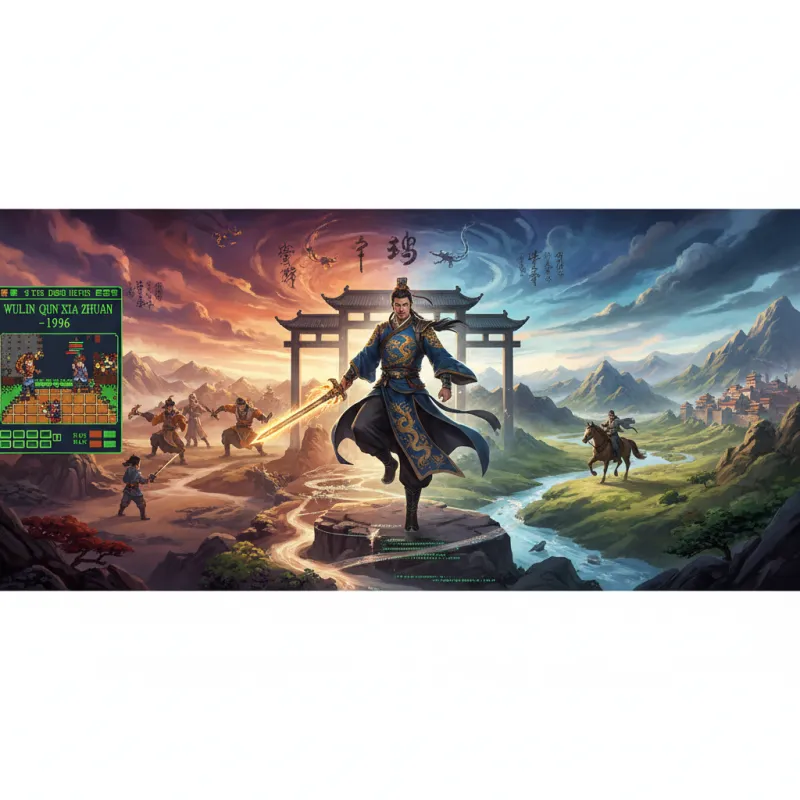
The first time I loaded up Jin Yong's Heroes on a borrowed 486 computer in 1996, I had no idea I was about to spend the next 80 hours wandering a pixelated jianghu that would define how an entire generation experienced wuxia. That clunky DOS game, with its MIDI soundtrack and 256-color sprites, did something no adaptation had managed before: it let you live in Jin Yong's world, making choices that could lead you to learn the Eighteen Dragon-Subduing Palms or accidentally poison yourself trying to master the Nine Yin Manual. Three decades later, Jin Yong video games have evolved from text-heavy RPGs to photorealistic open-world epics, but they're still chasing that same impossible dream — capturing the freedom and consequence of the martial arts world in interactive form.
The DOS Revolution: When Jianghu Went Digital
Before 1996, Jin Yong adaptations meant TV dramas and movies — passive experiences where you watched Guo Jing bumble his way to greatness or Linghu Chong drink himself into trouble. Then Heluo Studio in Taiwan released Jin Yong's Heroes (金庸群侠传 Jīnyōng Qúnxiá Zhuàn), and everything changed. The game's premise was audacious: take characters, locations, and martial arts from all fourteen Jin Yong novels and throw them into a single open world where you, a nobody with 10 points in every stat, could theoretically become the greatest martial artist who ever lived.
The genius was in the non-linearity. You could spend your early game grinding wild boars outside Niújiā Village (牛家村), or you could immediately sail to Peach Blossom Island and try to con Huang Yaoshi into teaching you. Want to learn the Dugu Nine Swords? Better figure out how to get Linghu Chong drunk enough to like you. Interested in the Sunflower Manual? Hope you're prepared for the consequences — yes, those consequences. The game didn't hold your hand, didn't explain its systems, and absolutely would let you lock yourself out of entire questlines by making the wrong choice in a random conversation.
Jin Yong's Heroes sold over 500,000 copies in Chinese-speaking markets, a staggering number for a PC game in 1996. More importantly, it established the template: open-world exploration, relationship systems with dozens of characters, martial arts that you actually had to find and learn rather than unlocking through a skill tree, and multiple endings based on your choices and martial arts mastery. Every Jin Yong game since has been measured against this DOS-era benchmark.
The Sequel Problem: Bigger Isn't Always Better
Heluo followed up with Legend of Jin Yong Heroes (金庸群侠传2 Jīnyōng Qúnxiá Zhuàn 2) in 2002, and it's a fascinating case study in how to misunderstand what made the original work. The sequel had better graphics, more characters, more martial arts, more everything — and somehow felt emptier. The problem was scope creep: instead of one cohesive world, you got disconnected story chapters. Instead of emergent gameplay where you discovered your own path, you got a more linear narrative that funneled you through predetermined scenarios.
The game sold well on nostalgia alone, but the community consensus was clear: they'd made it bigger without making it better. This would become a recurring pattern in Jin Yong gaming — developers kept adding features, graphics, and complexity while losing sight of what made wandering the jianghu compelling in the first place. The best Jin Yong games aren't the ones with the most content; they're the ones that make you feel like you're living in a wuxia novel, where your choices matter and reputation is earned through deeds, not cutscenes.
The MMO Experiment: When Everyone's the Hero
The 2000s brought the MMO boom to China, and Jin Yong's worlds seemed like perfect settings for massively multiplayer experiences. JX Online (剑侠情缘网络版 Jiànxiá Qíngyuán Wǎngluò Bǎn, 2003) wasn't technically a Jin Yong adaptation, but it borrowed heavily from his martial arts systems and became one of China's most successful MMOs. The actual licensed Jin Yong MMOs — Age of Wushu (九阴真经 Jiǔyīn Zhēnjīng, 2012) and others — tried to capture that single-player sense of martial arts progression in a multiplayer environment.
The results were mixed. On one hand, learning kung fu from other players, forming sects, and engaging in massive jianghu politics with real people created emergent stories that no single-player game could match. On the other hand, MMO economics inevitably crept in: pay-to-win mechanics, grinding for materials, and the reality that when everyone's trying to be Guo Jing or Yang Guo, nobody actually is. The jianghu works as a setting because most people are ordinary — innkeepers, merchants, farmers — which makes the martial artists special. When everyone's a martial artist, the magic dissipates.
Still, Age of Wushu deserves credit for its ambitious systems: a classless martial arts progression where you learned styles by finding manuals or convincing NPCs to teach you, a kidnapping system that let players capture each other for ransom or forced labor, and a school warfare system where sects could actually conquer territory. It was messy, unbalanced, and frequently broken, but it was also the closest any game has come to simulating the chaotic, consequence-driven world of Jin Yong's novels in multiplayer form.
Mobile Gaming: Gacha Meets Wuxia
The 2010s mobile gaming boom brought a flood of Jin Yong adaptations to smartphones, and most of them are exactly what you'd expect: gacha systems where you collect character cards, auto-battle mechanics, and energy systems that limit how much you can play. Games like Condor Heroes (神雕侠侣 Shéndiāo Xiálǚ, 2014) and Demigods and Semi-Devils (天龙八部 Tiānlóng Bābù, 2017) are technically competent, occasionally beautiful, and fundamentally soulless.
The problem isn't the platform — mobile devices are perfectly capable of delivering compelling experiences. The problem is the business model. When your primary goal is maximizing daily active users and encouraging microtransactions, you end up with games that feel like Skinner boxes dressed in wuxia clothing. You're not exploring the jianghu; you're completing daily quests to earn currency to pull for a 0.6% chance at SSR Yang Guo. The martial arts aren't learned through discovery and practice; they're unlocked by collecting enough character shards.
There are exceptions. River Lake (江湖X Jiānghú X, 2017) is a mobile game that actually understands Jin Yong's appeal: it's a text-heavy, choice-driven RPG with minimal graphics and maximum freedom. You read descriptions, make decisions, and watch your character's story unfold based on your choices. It's closer in spirit to the original DOS games than any of the big-budget mobile adaptations, and it found an audience precisely because it respected players' intelligence and time.
The Open-World Dream: Modern Attempts
The success of games like The Witcher 3 and Ghost of Tsushima proved that open-world action RPGs could deliver both narrative depth and exploration freedom. Chinese developers took notice, and the late 2010s saw several attempts to bring Jin Yong's worlds into the modern open-world format. Sword and Fairy 7 (仙剑奇侠传7 Xiānjiàn Qíxiá Zhuàn 7, 2021) wasn't a Jin Yong adaptation, but it showed Chinese studios could create AAA open-world experiences that felt authentically Chinese rather than like reskinned Western games.
The most ambitious recent attempt is Where Winds Meet (燕云十六声 Yānyún Shíliù Shēng), which promises a massive open-world wuxia experience with parkour, dynamic combat, and a living jianghu that reacts to your actions. Early footage looks stunning — characters running across rooftops, engaging in wire-fu combat, and exploring detailed Song Dynasty cities. Whether it can deliver on the promise of being "the Jin Yong game for the modern era" remains to be seen, but the ambition is there.
The challenge for modern Jin Yong games isn't technical — we have the graphics, the processing power, and the design knowledge to create incredible wuxia experiences. The challenge is philosophical: how do you balance the freedom that makes Jin Yong's world compelling with the structure that makes a game playable? How do you let players feel like they're discovering their own path while still telling a coherent story? How do you make martial arts progression feel earned rather than just another XP bar to fill?
What Makes a Great Jin Yong Game
After three decades of adaptations, certain patterns emerge. The best Jin Yong games share common elements: they respect player agency, they make martial arts learning feel like actual learning rather than just unlocking skills, they populate the world with characters who have their own goals and relationships beyond serving as quest-givers, and they understand that the jianghu is defined as much by its ordinary people as its legendary heroes.
Jin Yong's Heroes remains the gold standard not because of its graphics or combat system — both are primitive by modern standards — but because it understood that Jin Yong's appeal lies in the possibility of the martial arts world. You could be anyone, learn anything, go anywhere. The game trusted you to find your own story within its systems, and that trust created investment that no amount of cutscenes or voice acting can replicate.
The future of Jin Yong gaming probably lies somewhere between the freedom of those early DOS games and the production values of modern open-world titles. We need games that look like Ghost of Tsushima but play like Jin Yong's Heroes — beautiful, immersive worlds where you're not following a predetermined path but genuinely exploring, discovering, and making choices that matter. The technology exists. The question is whether developers have the courage to trust players with that much freedom, and whether publishers will fund games that prioritize depth over monetization.
For now, that 1996 DOS game remains installed on my computer, still playable through DOSBox, still capable of delivering that specific thrill of wandering into a random cave and finding a martial arts manual that changes everything. That's the magic Jin Yong games should be chasing — not bigger budgets or better graphics, but that moment when you realize the jianghu is yours to explore, and anything is possible.
Related Reading
- The Best TV Adaptations of Jin Yong's Novels
- Jin Yong on Screen: Why Every Adaptation Disappoints Someone
- Jin Yong's Global Influence: How Wuxia Went Worldwide
- Wuxia Films for Beginners: Where to Start
- Best and Worst Jin Yong Adaptations: A Definitive Guide
- Love Triangles in Jin Yong: When Heroes Can't Choose
- Jin Yong's Writing Style: What Makes It Timeless
- Exploring the Intricate Sects within Jin Yong's Iconic Wuxia Novels