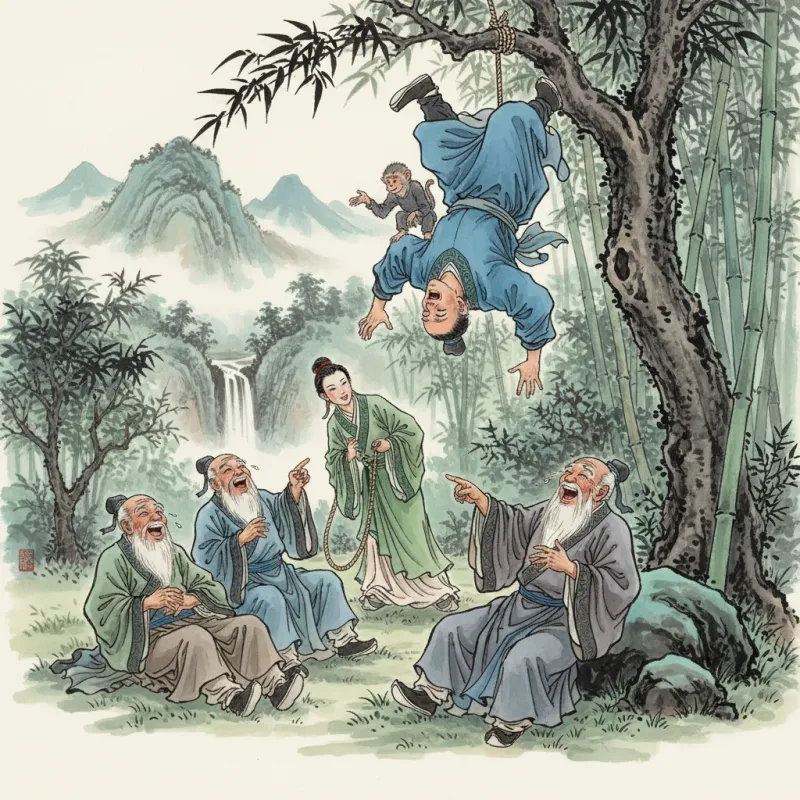
The humor in Jin Yong's wuxia (武侠 wǔxiá) fiction isn't incidental. It's structural. He understood that you can't sustain tension for fifty chapters without release, and he deployed comedy the way a great chef uses acid — to cut through richness and keep everything balanced. Let's look at the moments that prove Jin Yong deserved a comedy writing award alongside all those literary honors.
Wei Xiaobao's Entire Existence
If you want to understand Jin Yong's sense of humor, start with Wei Xiaobao (韦小宝 Wéi Xiǎobǎo) from The Deer and the Cauldron (鹿鼎记 Lù Dǐng Jì). This character is Jin Yong's middle finger to every wuxia convention he'd spent decades establishing. Wei Xiaobao can't do martial arts. He's a compulsive liar. He's crude, opportunistic, and morally flexible in ways that would make a politician blush.
And he's absolutely brilliant.
The genius is that Jin Yong makes you root for this little scoundrel. When Wei Xiaobao accidentally becomes a high-ranking official in the Qing court through a series of misunderstandings and shameless flattery, you're not watching a hero's journey — you're watching a con artist improvise his way through history. The scene where he "translates" the Forty-Two Chapter Sutra without being able to read it, making up complete nonsense that everyone accepts as profound wisdom, is comedy gold. It's also a sly commentary on how authority and expertise are often just confidence plus circumstance.
Jin Yong wrote this novel late in his career, and you can feel him having fun. After creating so many righteous heroes and tragic figures, he gave himself permission to write someone who survives purely on luck and bullshit. The fact that Wei Xiaobao ends up more successful than most of Jin Yong's "proper" heroes is the ultimate joke.
Guo Jing's Spectacular Density
Guo Jing (郭靖 Guō Jìng) from The Legend of the Condor Heroes (射雕英雄传 Shè Diāo Yīngxióng Zhuàn) is the protagonist, the hero, the guy who saves the nation. He's also denser than a brick wall, and Jin Yong never lets you forget it.
The running gag throughout the novel is that Guo Jing is so earnest and literal-minded that he misses every social cue, every hint, every obvious romantic signal. When Huang Rong (黄蓉 Huáng Róng) — one of the smartest characters in the entire Jin Yong universe — is clearly interested in him, Guo Jing treats her like a helpful buddy. She has to practically spell it out in neon letters before he catches on.
But here's what makes it work: Guo Jing's obliviousness isn't played for cruelty. Jin Yong uses it to show that intelligence comes in different forms. Guo Jing might not understand flirting or sarcasm, but he grasps martial arts principles that elude faster minds because he practices them ten thousand times without getting bored. His simplicity is both the joke and the point. In a world full of schemers and geniuses, the straightforward guy wins through sheer persistence.
The funniest moment might be when the Seven Freaks of Jiangnan (江南七怪 Jiāngnán Qī Guài) are trying to teach him, and he takes everything so literally that they want to tear their hair out. One of them demonstrates a move and says "it's like this," and Guo Jing copies the exact posture, including the teacher's scratching his head mid-demonstration. That's physical comedy in a written novel, and it works.
Linghu Chong's Drinking Buddies
The Smiling, Proud Wanderer (笑傲江湖 Xiào Ào Jiānghú) has a darker tone than some Jin Yong novels, dealing with political manipulation and moral corruption in the martial arts world. Which makes the comedy moments hit even harder.
Linghu Chong (令狐冲 Línghú Chōng) befriending a group of eccentric outcasts — including Zu Qianqiu (祖千秋 Zǔ Qiānqiū), the wine connoisseur who has elaborate theories about which wine goes with which mood — provides some of the novel's best comic relief. These aren't noble heroes. They're basically a bunch of middle-aged guys who've opted out of the rat race to drink and argue about music and wine.
The scene where Zu Qianqiu explains his wine philosophy is peak Jin Yong humor. He's completely serious about the "correct" vessel for each type of wine — jade cups for this, luminous cups for that, bronze for another. It's pretentious and absurd, but also kind of charming because he genuinely cares. Linghu Chong, who just wants to get drunk and forget his problems, has to sit through these lectures. The contrast between Zu Qianqiu's refined snobbery and Linghu Chong's "whatever gets me drunk" attitude creates a odd-couple dynamic that Jin Yong milks for all it's worth.
What's clever is that these comic characters aren't throwaway. They become crucial to the plot, and their friendship with Linghu Chong matters. Jin Yong understood that humor doesn't undermine seriousness — it makes the serious moments land harder because you've grown to love these ridiculous people.
The Absolute Chaos of Peach Blossom Island
Huang Yaoshi (黄药师 Huáng Yàoshī), the master of Peach Blossom Island (桃花岛 Táohuā Dǎo), is supposed to be one of the Five Greats, a martial arts legend. He's also running what amounts to a dysfunctional household that would make a great sitcom.
His disciples are a collection of misfits with weird specializations. One is obsessed with mathematics and formations. Another is deaf. They're all terrified of him, but also clearly care about each other in a bickering-family kind of way. When Guo Jing shows up, the disciples' attempts to test him while also not getting in trouble with their unpredictable master creates a comedy of errors.
The best part is Huang Yaoshi himself. He's brilliant, temperamental, and has the emotional regulation of a toddler. When he's in a good mood, he's charming and generous. When he's annoyed, he might just kick you off the island. His daughter Huang Rong inherited his intelligence but also his tendency toward dramatic gestures, which explains a lot about her relationship with the long-suffering Guo Jing.
Jin Yong uses Peach Blossom Island to show that even legendary martial artists are just people with quirks and bad days. The gap between Huang Yaoshi's fearsome reputation and his actual personality — which includes sulking when things don't go his way — is a running joke that humanizes a character who could have been a one-dimensional wise master.
Zhou Botong's Eternal Childhood
Zhou Botong (周伯通 Zhōu Bótōng) might be Jin Yong's purest expression of joy. This old martial arts master has the personality of a golden retriever puppy. He's easily distracted, loves games, holds grudges for about five minutes, and approaches life with infectious enthusiasm.
The comedy comes from the contrast between his age and skill level versus his behavior. He's one of the most powerful martial artists in the world, and he uses that power to... play pranks and invent new games. When he's trapped in a cave for years, does he become bitter? No, he invents a whole new martial arts style based on fighting yourself because he was bored and wanted a sparring partner.
His interactions with Guo Jing are particularly funny because Guo Jing takes everything seriously, and Zhou Botong takes nothing seriously. Zhou Botong teaches Guo Jing advanced techniques while treating it like a fun game, which accidentally makes him a better teacher than the stern Seven Freaks. There's a sly point here about how learning works better when it's playful, but Jin Yong doesn't hammer it — he just shows you Zhou Botong having a blast.
The scene where Zhou Botong meets Huang Yaoshi and they immediately start competing over who can be more petty is comedy gold. Two of the world's greatest martial artists, acting like children. Jin Yong loved deflating pomposity, and Zhou Botong is his instrument for doing it.
Yue Buqun's Performative Righteousness
Not all Jin Yong's humor is lighthearted. Sometimes it's dark and satirical, and nowhere is that clearer than with Yue Buqun (岳不群 Yuè Bùqún) from The Smiling, Proud Wanderer.
Yue Buqun is the head of the Huashan Sect (华山派 Huàshān Pài), and he's obsessed with appearing righteous and proper. Every action is calculated for maximum moral appearance. He speaks in platitudes about honor and justice while maneuvering for power behind the scenes. The humor is in how transparent his act is to the reader, even as other characters buy it.
Jin Yong makes Yue Buqun's dialogue increasingly ridiculous as the novel progresses. He'll say something like "As a gentleman of the martial arts world, I must consider what is righteous" right before doing something completely self-serving. It's funny in a cringe way, like watching someone lie badly and not realize everyone can tell.
The ultimate joke is that Yue Buqun's obsession with appearing noble leads him to do increasingly ignoble things, until he's castrated himself for power while still talking about righteousness. It's dark comedy, but it's comedy nonetheless — a satire of how people use moral language to justify terrible actions. Jin Yong was writing about politics and hypocrisy, but he made it entertaining by making Yue Buqun so absurdly self-deluded.
The Beggar Clan's Democratic Chaos
The Beggar Clan (丐帮 Gàibāng) appears across multiple Jin Yong novels, and it's consistently a source of comedy. Here's an organization of homeless people that has strict hierarchy, elaborate rules, and takes itself very seriously. The contrast between their circumstances and their formality is inherently funny.
In The Legend of the Condor Heroes, the scenes where the Beggar Clan holds meetings are pure comedy. They have parliamentary procedures. They debate motions. They have factions and politics. It's like watching a homeless encampment run according to Robert's Rules of Order. Jin Yong clearly enjoyed the absurdity of it.
Hong Qigong (洪七公 Hóng Qīgōng), the Beggar Clan leader, adds another layer. He's one of the Five Greats, a legendary martial artist, and he's obsessed with food to the point where he'll abandon important duties if someone mentions a good restaurant. His teaching Guo Jing martial arts in exchange for Huang Rong's cooking is a transaction that makes perfect sense to him and seems insane to everyone else.
The Beggar Clan represents Jin Yong's democratic instincts — even beggars can have organization and dignity — but he never makes them noble in a boring way. They're argumentative, petty, and obsessed with protocol, which makes them feel real and human rather than idealized.
Why Jin Yong's Humor Matters
The comedy in Jin Yong's novels isn't just entertainment, though it certainly is that. It's how he keeps you reading through thousands of pages. It's how he makes you care about characters. And it's how he sneaks in social commentary without being preachy.
When Wei Xiaobao succeeds through shamelessness, Jin Yong is questioning what we mean by "success." When Guo Jing's simplicity proves more effective than cleverness, he's challenging assumptions about intelligence. When Zhou Botong finds joy in everything, he's modeling a way of being that's rare in both fiction and life.
The humor also makes the tragic moments hit harder. You can't have The Return of the Condor Heroes (神雕侠侣 Shén Diāo Xiá Lǚ) without the lighter moments in The Legend of the Condor Heroes. The comedy establishes a baseline of normalcy and joy, which makes the suffering meaningful rather than just relentless.
Jin Yong understood something that a lot of "serious" writers miss: humor doesn't undermine depth. It creates it. Real life contains both tragedy and absurdity, often in the same moment. His novels feel true because they contain that full range. You can read about political intrigue and martial arts philosophy, and also laugh at a grown man throwing a tantrum because someone ate his favorite dish.
That's the mark of a complete writer. Jin Yong gave us heroes and villains, love and loss, history and fantasy. But he also gave us Wei Xiaobao conning his way through the imperial court, Guo Jing completely missing obvious flirtation, and Zhou Botong inventing games in a cave. The novels wouldn't work without both sides.
So next time someone tells you Jin Yong wrote serious literature about Chinese history and martial arts philosophy, agree with them. Then mention that he also wrote some of the funniest scenes in Chinese fiction, and those two facts aren't contradictory — they're the same achievement.
Related Reading
- Zhou Botong: The Old Urchin Who Never Grew Up
- Wei Xiaobao: The Funniest Character in Chinese Literature
- The Humor of Jin Yong: Comedy in the Martial World
- Jin Yong's Humor: The Comedy Hidden Inside the Tragedy
- How the Condor Trilogy Connects: Characters, Weapons, and Secrets Across 155 Years
- Discovering the Enchanting Locations of Jin Yong's Wuxia Novels
- The Enigmatic Hidden Techniques in Jin Yong’s Wuxia Novels Explored