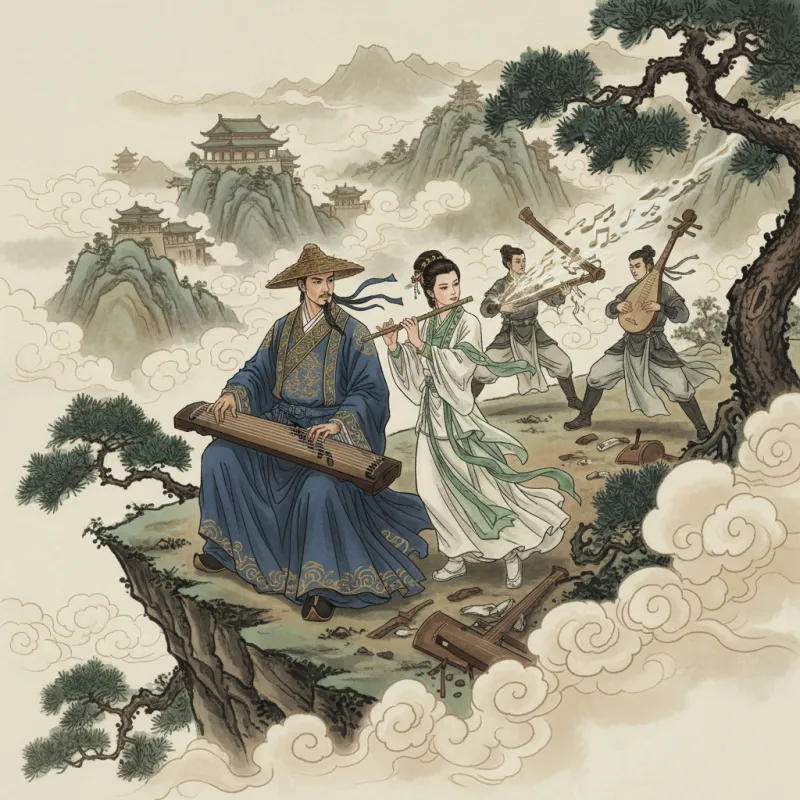
When Huang Yaoshi plucks the strings of his guqin on Peach Blossom Island, the sound doesn't just carry across the water — it kills. The notes themselves become invisible blades, slicing through the air with the precision of a master swordsman's strike. This isn't metaphor. In Jin Yong's (金庸 Jīn Yōng) wuxia universe, musical instruments are as deadly as any weapon forged in steel, and far more elegant. They represent the highest ideal of Chinese martial culture: the scholar-warrior (文武双全 wénwǔ shuāngquán) who can compose poetry at dawn and defend the realm by dusk.
The Guqin: When Scholarship Becomes Slaughter
The guqin (古琴 gǔqín), that seven-stringed zither revered by Confucian scholars for three millennia, undergoes a radical transformation in Jin Yong's hands. Traditionally an instrument of meditation and self-cultivation, it becomes a weapon of mass destruction when wielded by masters like Huang Yaoshi (黄药师 Huáng Yàoshī) in The Legend of the Condor Heroes (射雕英雄传 Shèdiāo Yīngxióng Zhuàn).
Huang's "Jade Flute Swordplay" (玉箫剑法 Yùxiāo Jiànfǎ) and his guqin techniques aren't just combat skills — they're philosophical statements. He's called "Eastern Heretic" (东邪 Dōng Xié) precisely because he takes the most refined symbol of orthodox culture and weaponizes it. The guqin, which Confucius himself played to cultivate virtue, becomes an instrument of heterodox power. This inversion is quintessentially Jin Yong: taking cultural symbols and revealing their hidden violence, their capacity for destruction when divorced from moral restraint.
The mechanics matter here. When Huang plays, he channels his internal energy (内力 nèilì) through the strings, transforming sound waves into concussive force. The technique requires extraordinary control — too much power and the strings snap, too little and the attack dissipates harmlessly. It's a perfect metaphor for the balance required in martial arts mastery, and for the dangerous edge of genius itself. Huang Yaoshi is brilliant, but his brilliance makes him dangerous, unpredictable, heretical.
The Xiao: Melancholy as Martial Art
If the guqin represents intellectual power weaponized, the xiao (箫 xiāo) — the vertical bamboo flute — embodies something more intimate and tragic. This is the instrument of lonely heroes, of characters who've lost too much to ever fully return to the world of ordinary human connection.
Huang Yaoshi again provides the definitive example. His xiao playing on Peach Blossom Island isn't just beautiful — it's haunted. After his wife's death, his music becomes a form of mourning that never ends, a grief so profound it can kill those who hear it unprepared. The "Jade Flute Swordplay" he teaches his daughter Huang Rong (黄蓉 Huáng Róng) combines xiao melodies with sword techniques, creating a fighting style that's as much about emotional expression as combat effectiveness.
The xiao appears throughout Jin Yong's work as a marker of refined suffering. In The Smiling, Proud Wanderer (笑傲江湖 Xiào'ào Jiānghú), the piece "Smiling Proud Wanderer" (笑傲江湖曲 Xiào'ào Jiānghú Qǔ) itself becomes central to the plot — a musical composition that represents freedom from orthodox constraints, played on xiao and guqin in duet. The music here isn't a weapon but a philosophy, a way of being in the world that rejects both orthodox and heterodox power structures. Liu Zhengfeng (刘正风 Liú Zhèngfēng) and Qu Yang (曲洋 Qǔ Yáng), one from the orthodox martial world and one from the demonic Sun Moon Holy Cult, create this music together, and it costs them their lives. Their friendship, expressed through music, is more dangerous than any sword technique because it threatens the very categories that give the martial world its structure.
The Pipa: Seduction and Sonic Warfare
The pipa (琵琶 pípá), that pear-shaped lute with its distinctive plucking technique, carries different connotations in Jin Yong's fiction. Where the guqin suggests scholarly refinement and the xiao suggests melancholy isolation, the pipa often appears in contexts of seduction, entertainment, and feminine power.
In Demi-Gods and Semi-Devils (天龙八部 Tiānlóng Bābù), musical combat reaches perhaps its most sophisticated expression. The novel features multiple characters who use sound-based martial arts, creating a complex acoustic battlefield where different instruments and techniques clash. The "Lion's Roar" (狮子吼 Shīzi Hǒu) technique, though not instrument-based, establishes that sound itself can be weaponized through internal energy cultivation.
What's fascinating is how Jin Yong uses different instruments to code different types of power and different relationships to orthodox culture. The guqin is the weapon of the educated elite, those who've mastered the classics. The xiao is for the romantic outsider, the genius who can't quite fit into society. The pipa, with its associations with entertainment and the pleasure quarters, represents a more ambiguous, potentially subversive form of cultural power. These aren't arbitrary choices — they reflect centuries of Chinese cultural associations, which Jin Yong both honors and subverts.
The Mechanics of Musical Martial Arts
How does this actually work? Jin Yong provides surprisingly consistent internal logic for his musical combat systems. The fundamental principle is that sound waves, when infused with internal energy, become physical force. This isn't entirely fantastical — sound is vibration, and vibration is physical. Jin Yong simply extends the principle to supernatural extremes.
The practitioner must master three elements simultaneously: musical technique (knowing how to play the instrument properly), internal energy cultivation (developing sufficient qi to channel through the music), and martial application (understanding how to direct the sonic force toward specific targets). This triple mastery explains why musical martial arts are relatively rare in Jin Yong's world — they require both cultural refinement and martial prowess, the true embodiment of wénwǔ shuāngquán.
Different instruments offer different tactical advantages. The guqin, being stationary, works best for defensive positions or ambushes. The xiao is portable, allowing for mobile combat, but requires both hands and thus prevents the use of other weapons. The pipa offers a middle ground — portable but still requiring two hands for proper technique. These practical considerations shape how characters use musical martial arts in actual combat situations.
Music, Memory, and Martial Identity
What elevates Jin Yong's treatment of musical instruments beyond mere combat gimmickry is how he connects music to character psychology and narrative theme. Music in his novels is always about something more than fighting — it's about memory, loss, identity, and the possibility (or impossibility) of human connection across ideological divides.
Consider again "Smiling Proud Wanderer," the musical piece that gives Xiào'ào Jiānghú its title. The music represents an ideal of freedom and friendship that the martial world's power structures cannot tolerate. Liu Zhengfeng and Qu Yang's collaboration across factional lines is more threatening than any martial technique because it suggests that the categories of "orthodox" and "demonic" might be arbitrary, that human connection might transcend political allegiance. They die for this suggestion, but the music survives, passed on to Linghu Chong (令狐冲 Línghú Chōng), who embodies its philosophy of wandering freedom.
Similarly, Huang Yaoshi's music is inseparable from his grief for his dead wife. His mastery of musical martial arts doesn't compensate for his loss — if anything, it emphasizes it. He's so powerful he can kill with a melody, yet he cannot bring back the one person he truly loved. The music becomes a monument to absence, a way of keeping grief alive through aesthetic perfection. This is deeply Chinese in sensibility — the idea that art preserves what life cannot sustain, that beauty and sorrow are inseparable.
The Cultural Resonance
Jin Yong's musical martial arts tap into deep currents in Chinese cultural history. The association between music and cosmic order goes back to the earliest Chinese philosophical texts. The Book of Rites (礼记 Lǐjì) describes music as a force that can harmonize heaven and earth, that can literally affect the natural world through its patterns and resonances. Confucius considered music essential to moral education. The legendary musician Shi Kuang (师旷 Shī Kuàng) was said to be able to summon winds and identify the rise and fall of kingdoms through musical tones.
Jin Yong takes these traditional associations and pushes them into the realm of martial fantasy, but he never entirely abandons their philosophical foundations. When Huang Yaoshi plays his guqin, he's not just attacking enemies — he's expressing a worldview, a relationship to culture and power that marks him as "heretical" precisely because it's so refined. He's too cultured for the orthodox martial world, too violent for the scholarly world. The music places him in an impossible position, which is exactly where Jin Yong's most interesting characters always find themselves.
The instruments themselves carry historical weight. The guqin tradition stretches back over three thousand years, with specific pieces and playing techniques preserved across dynasties. The xiao has similar antiquity, associated with Daoist hermits and Buddhist monks as well as Confucian scholars. By making these instruments into weapons, Jin Yong asks uncomfortable questions about the relationship between culture and violence, refinement and power. Can the same hands that create beauty also deal death? His answer is unambiguous: not only can they, but perhaps they must. In the martial world, there is no pure aestheticism, no art divorced from power.
The Legacy in Modern Wuxia
Jin Yong's treatment of musical instruments has influenced virtually every wuxia writer who came after him. The image of the warrior-musician, the deadly melody, the combat conducted through aesthetic means — these have become standard elements of the genre. Yet few writers have matched Jin Yong's ability to make musical combat feel both spectacular and meaningful, both fantastical and emotionally grounded.
What makes his approach work is that the music is never just a combat technique. It's always also characterization, theme, philosophy. When we see Huang Yaoshi play his guqin, we're not just watching a fight scene — we're seeing a man's entire relationship to culture, power, grief, and genius expressed through sound. The music tells us who he is in ways that dialogue or description never could.
This integration of combat and character, of martial spectacle and emotional depth, is what separates Jin Yong from his imitators. The musical instruments in his novels aren't gimmicks or power-ups — they're extensions of character psychology, symbols of cultural values, and narrative devices that allow him to explore the relationship between art and violence, refinement and power, tradition and innovation. They're weapons, yes, but they're also arguments about what it means to be cultured, what it means to be powerful, and whether those two things can ever truly be reconciled.
In the end, the musical instruments in Jin Yong's wuxia world remind us that in Chinese cultural imagination, there has never been a clear line between the aesthetic and the martial, between creating beauty and wielding power. The same discipline that produces a perfect musical note can produce a perfect sword strike. The same sensitivity that allows one to appreciate poetry allows one to read an opponent's intentions. The scholar-warrior ideal isn't about being good at two separate things — it's about recognizing that at the highest levels, they're the same thing. The music is the martial art. The martial art is the music. And in that fusion, Jin Yong found one of his most powerful and enduring images.
Related Reading
- Jin Yong's Music: The Soundtracks That Made a Nation Cry
- The Xiao Ao Jianghu Theme Song: Music as Philosophy
- The Iconic Soundtracks of Jin Yong TV Adaptations
- Poetry in Jin Yong's Novels: Classical Verse as Narrative Weapon
- The Food and Drink of Jin Yong: What Heroes Eat Between Sword Fights
- Buddhism and Martial Arts: Spiritual Themes
- The Allure of Jin Yong's Wuxia: Exploring Martial Arts, Characters, and Legendary Storylines