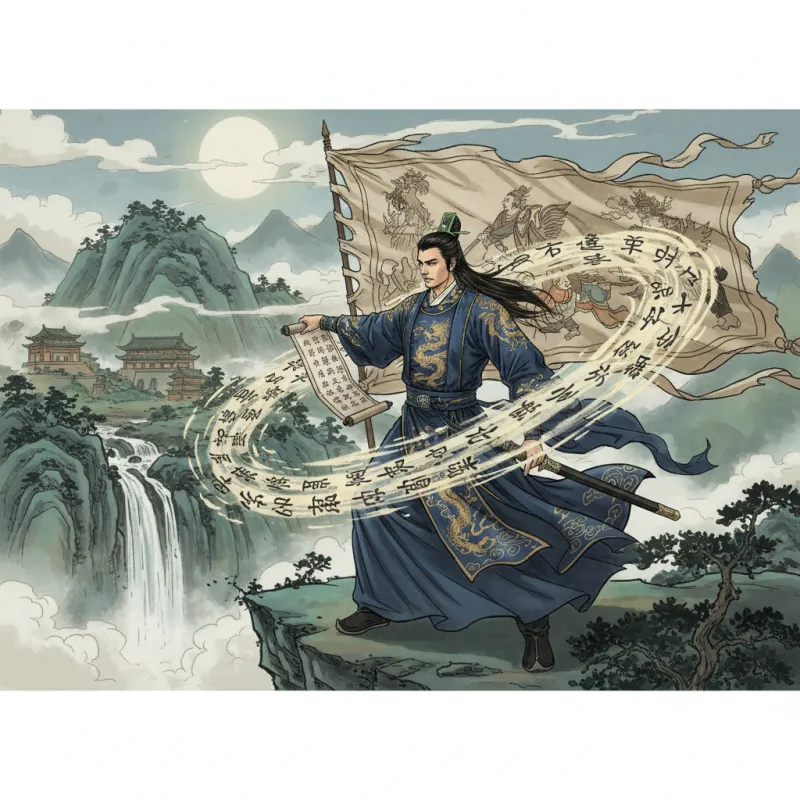
Poetry in Jin Yong Novels: Classical Verse as Narrative Weapon
The year is 1963. In a Hong Kong newspaper office, Louis Cha Leung-yung (查良鏞, Chá Liángyōng)—better known by his pen name Jin Yong (金庸, Jīn Yōng)—sits at his typewriter, crafting a scene that will become one of Chinese literature's most memorable moments. In Demi-Gods and Semi-Devils (《天龙八部》, Tiānlóng Bābù), the Shaolin monk Xuzhu (虚竹, Xūzhú) encounters a go board puzzle at the Leigu Mountain (擂鼓山, Léigǔ Shān). Inscribed beside it are four lines from a Tang dynasty poem: "珍珑如玉剑如虹,蝶舞翩翩过小桥" (Zhēnlóng rú yù jiàn rú hóng, dié wǔ piānpiān guò xiǎo qiáo)—"Exquisite as jade, sword like rainbow, butterflies dance gracefully across the small bridge." These verses aren't mere decoration. They contain the solution to an impossible weiqi (围棋, wéiqí) problem that has stumped martial arts masters for decades. Jin Yong understood something fundamental: in Chinese culture, poetry isn't just aesthetic—it's a weapon, a code, a key to power itself.
The Scholar-Warrior Tradition
Jin Yong's integration of classical poetry into martial arts fiction draws from a millennium-old Chinese ideal: the scholar-warrior (文武双全, wénwǔ shuāngquán). This concept, literally "complete in both civil and military arts," appears throughout his seventeen novels written between 1955 and 1972. Unlike Western fantasy where magic and swordplay exist in separate spheres, Jin Yong's universe treats literary cultivation and martial prowess as complementary paths to enlightenment.
Consider Guo Jing (郭靖, Guō Jìng), the protagonist of The Legend of the Condor Heroes (《射雕英雄传》, Shèdiāo Yīngxióng Zhuàn, 1957-1959). Though initially portrayed as slow-witted and illiterate, Guo Jing's eventual mastery of the Eighteen Dragon-Subduing Palms (降龙十八掌, Jiàng Lóng Shíbā Zhǎng) comes only after he learns to understand the philosophical principles encoded in classical texts. His teacher, Hong Qigong (洪七公, Hóng Qīgōng), explains each palm technique through references to the Book of Changes (《易经》, Yìjīng), demonstrating how ancient wisdom translates into physical force.
The contrast becomes sharper with Huang Rong (黄蓉, Huáng Róng), Guo Jing's eventual wife and daughter of the eccentric genius Huang Yaoshi (黄药师, Huáng Yàoshī). Huang Rong defeats opponents not through superior strength but through her encyclopedic knowledge of classical literature. In one scene, she escapes capture by reciting lines from The Book of Songs (《诗经》, Shījīng, circa 1000 BCE) that contain hidden instructions for her allies. The poetry becomes literal code, incomprehensible to the illiterate bandits but crystal clear to educated confederates.
The Nine Yin Manual and Daoist Verse
Perhaps no artifact in Jin Yong's universe better illustrates poetry's martial function than the Nine Yin Manual (《九阴真经》, Jiǔyīn Zhēnjīng), which appears across multiple novels. This legendary text, supposedly written by the Daoist master Huang Shang (黄裳, Huáng Shang) during the Northern Song dynasty (960-1127 CE), contains the most powerful martial arts techniques in the jianghu (江湖, jiānghú)—the martial arts underworld.
The Manual's opening lines are pure classical Chinese poetry: "天之道,损有余而补不足,是故虚胜实,不足胜有余" (Tiān zhī dào, sǔn yǒuyú ér bǔ bùzú, shìgù xū shèng shí, bùzú shèng yǒuyú)—"The way of Heaven is to reduce the excessive and supplement the deficient; thus emptiness overcomes fullness, insufficiency overcomes excess." These lines, adapted from the Daodejing (《道德经》, Dàodéjīng), aren't metaphorical. They describe actual combat principles: yielding defeats rigidity, softness overcomes hardness.
Jin Yong's genius lies in making this connection explicit. When Zhou Zhiruo (周芷若, Zhōu Zhǐruò) in The Heaven Sword and Dragon Saber (《倚天屠龙记》, Yǐtiān Túlóng Jì, 1961) studies the Nine Yin Manual, she must first master classical Chinese prosody before she can execute the techniques. The martial arts movements themselves follow the tonal patterns of regulated verse (律诗, lǜshī): level tones (平声, píngshēng) correspond to defensive moves, oblique tones (仄声, zèshēng) to attacks. A fighter who cannot distinguish these poetic tones will mistime their strikes and leave themselves vulnerable.
The Orchid Pavilion Gathering and Calligraphic Combat
In The Smiling, Proud Wanderer (《笑傲江湖》, Xiào'ào Jiānghú, 1967), Jin Yong takes the poetry-as-weapon concept to its logical extreme. The novel's protagonist, Linghu Chong (令狐冲, Línghú Chōng), discovers that the legendary swordplay manual hidden in the Huashan (华山, Huàshān) caves is actually a series of poems and calligraphic works.
The key text is Wang Xizhi's (王羲之, Wáng Xīzhī, 303-361 CE) Preface to the Poems Composed at the Orchid Pavilion (《兰亭集序》, Lántíng Jí Xù). This masterpiece of Chinese calligraphy, written in 353 CE during a poetry gathering, contains within its brushstrokes the essence of supreme swordplay. Each character's structure—the balance of strokes, the flow of ink, the rhythm of composition—encodes a sword technique.
Jin Yong describes how Linghu Chong must learn to "read" the calligraphy not as text but as movement. The character 之 (zhī), with its flowing diagonal stroke, teaches the technique of deflecting an opponent's blade. The character 永 (yǒng), the "eight principles of yong" (永字八法, yǒngzì bāfǎ) used to teach calligraphy basics, contains eight fundamental sword positions. This isn't fantasy—it's an extrapolation of real Chinese martial arts philosophy, where taijiquan (太极拳, tàijíquán) practitioners are taught that their movements should flow like calligraphic brushstrokes.
The Condor Trilogy and Tang Poetry
The Condor Trilogy—The Legend of the Condor Heroes, The Return of the Condor Heroes (《神雕侠侣》, Shéndiāo Xiálǚ, 1959-1961), and The Heaven Sword and Dragon Saber—spans nearly a century of fictional history and showcases Jin Yong's most sophisticated use of Tang dynasty (618-907 CE) poetry.
In The Return of the Condor Heroes, the protagonist Yang Guo (杨过, Yáng Guò) learns the Jade Maiden Heart Sutra (玉女心经, Yùnǚ Xīnjīng) from his teacher and eventual lover, Xiaolongnü (小龙女, Xiǎolóngnǚ). This martial arts manual is structured as a series of poems in the style of Li Bai (李白, Lǐ Bái, 701-762) and Du Fu (杜甫, Dù Fǔ, 712-770). Each couplet describes a paired sword technique meant to be performed by two people in perfect harmony.
One sequence references Li Bai's famous line "举杯邀明月,对影成三人" (Jǔ bēi yāo míngyuè, duì yǐng chéng sān rén)—"Raising my cup, I invite the bright moon; facing my shadow makes us three." In the martial context, this becomes a technique where two fighters create the illusion of a third combatant through synchronized movements and shadow play. The poetry isn't just inspiration—it's the instruction manual itself.
Buddhist Sutras and Martial Enlightenment
Jin Yong, whose Buddhist name was Cha Liangyong (查良镛, Chá Liángyōng), frequently incorporated Buddhist texts into his martial arts systems. In Demi-Gods and Semi-Devils (1963-1966), the Shaolin Temple's 72 unique skills (七十二绝技, qīshí'èr juéjì) are each linked to specific Buddhist sutras.
The novel's most powerful technique, the Yijin Jing (易筋经, Yìjīn Jīng, "Muscle-Tendon Change Classic"), is presented as a Sanskrit text translated into classical Chinese verse. The protagonist Duan Yu (段誉, Duàn Yù) accidentally masters the Beiming Divine Art (北冥神功, Běimíng Shéngōng) by reading what he thinks is a Daoist philosophical text. The opening lines quote Zhuangzi (庄子, Zhuāngzǐ, 369-286 BCE): "北冥有鱼,其名为鲲" (Běimíng yǒu yú, qí míng wéi kūn)—"In the Northern Darkness there is a fish, its name is Kun."
What Duan Yu doesn't realize is that this poetic passage contains breathing techniques and internal energy circulation methods. The "fish" represents qi (气, qì) flowing through meridians; the "Northern Darkness" refers to the dantian (丹田, dāntián) energy center below the navel. By reciting the verses while meditating, Duan Yu inadvertently practices advanced neigong (内功, nèigōng, internal cultivation).
The Sword Debate at Mount Hua
The recurring motif of the Sword Debate at Mount Hua (华山论剑, Huàshān Lùnjiàn) across Jin Yong's novels represents the ultimate fusion of literary and martial prowess. These gatherings, where the world's greatest martial artists compete for the title of "Number One Under Heaven" (天下第一, Tiānxià Dìyī), aren't mere fighting tournaments. They're scholarly debates where contestants must defend their martial philosophies through classical argumentation.
In The Legend of the Condor Heroes, the Five Greats (五绝, Wǔjué) who compete at Mount Hua each represent different schools of classical Chinese thought. Wang Chongyang (王重阳, Wáng Chóngyáng), the "Central Divine" (中神通, Zhōng Shéntōng), embodies Daoist philosophy. His martial arts are inseparable from his ability to quote and interpret the Daodejing. When he defeats Ouyang Feng (欧阳锋, Ōuyáng Fēng), the "Western Venom" (西毒, Xī Dú), it's not just through superior technique but through superior understanding of the Daoist principle of wuwei (无为, wúwéi, non-action).
Legacy and Literary Innovation
Jin Yong's integration of classical poetry into martial arts fiction represents a unique literary achievement. Between 1955 and 1972, his seventeen novels sold over 300 million copies worldwide, making him one of the most widely-read Chinese authors of the 20th century. His innovation wasn't simply adding poetic quotations to action scenes—it was reconceptualizing Chinese classical literature as a living, functional system of knowledge.
This approach resonated deeply with Chinese readers because it reflected actual historical practice. During the Ming (1368-1644) and Qing (1644-1912) dynasties, military examinations (武举, wǔjǔ) required candidates to demonstrate both martial skills and classical literacy. Generals were expected to compose poetry; scholars studied military strategy. Jin Yong's fictional universe, where a character's martial power correlates with their literary cultivation, isn't pure fantasy—it's an idealized reflection of Chinese cultural values.
The influence extends beyond literature. Modern Chinese martial arts films, from Zhang Yimou's Hero (2002) to Wong Kar-wai's The Grandmaster (2013), incorporate Jin Yong's concept of poetry-as-martial-art. Video games like Sword and Fairy (《仙剑奇侠传》, Xiānjiàn Qíxiá Zhuàn) feature combat systems where players must solve classical poetry puzzles to unlock techniques.
Jin Yong passed away in 2018 at age 94, but his literary legacy endures. His novels remain required reading for understanding modern Chinese popular culture, and his innovation—treating classical poetry not as dead text but as living martial knowledge—continues to influence how Chinese audiences engage with their literary heritage. In Jin Yong's universe, the pen truly is mightier than the sword, because the pen teaches you how to wield the sword.
Related Reading
- The Iconic Soundtracks of Jin Yong TV Adaptations
- Jin Yong's Music: The Soundtracks That Made a Nation Cry
- Musical Instruments in Jin Yong's Wuxia World
- The Xiao Ao Jianghu Theme Song: Music as Philosophy
- The Enduring Legacy of Jin Yong’s Wuxia Novels: Characters, Martial Arts, and Cultural Influence
- Wine Culture in Jin Yong's Wuxia World
- The Smiling, Proud Wanderer: A Complete Guide