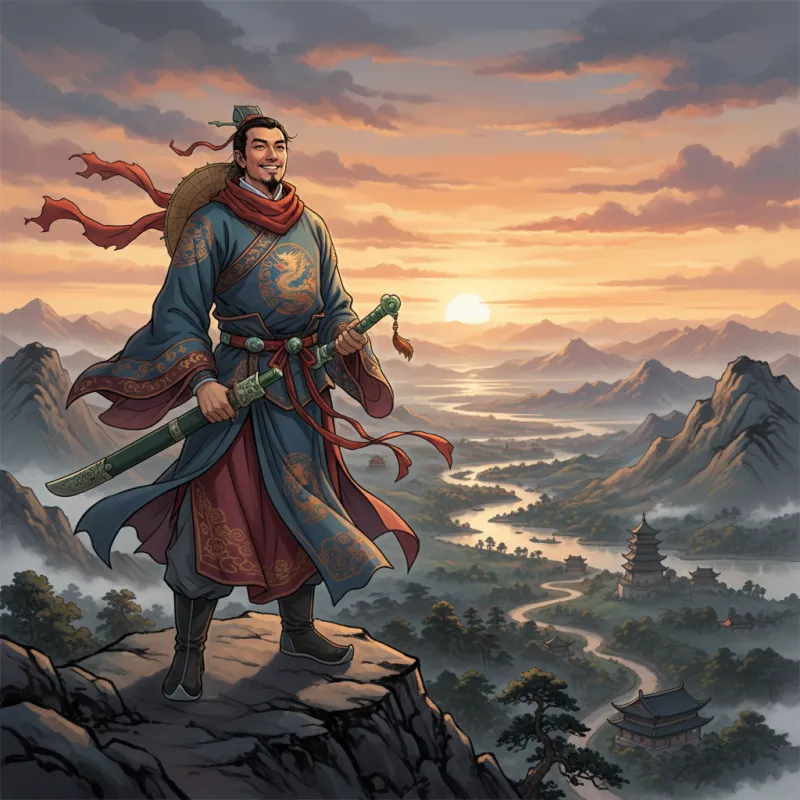
Linghu Chong gets drunk, plays his zither, and watches the world burn around him. While other Jin Yong heroes obsess over revenge, duty, or saving the realm, this guy just wants to drink wine, make music, and be left alone. The problem? Everyone else in 笑傲江湖 (Xiào Ào Jiānghú, The Smiling, Proud Wanderer) is too busy scheming, backstabbing, and murdering their way to power to let him do that. Written between 1967 and 1969 during the Cultural Revolution, this isn't just Jin Yong's most political novel—it's his angriest, and possibly his best.
Why This Novel Feels Different
Most Jin Yong novels follow a pattern: young hero suffers injustice, learns amazing kung fu, defeats the bad guys, gets the girl. 笑傲江湖 throws that formula in the trash. Linghu Chong (令狐冲 Lìnghú Chōng) starts out as a talented disciple of the prestigious Huashan Sect (华山派 Huáshān Pài), but he never becomes the strongest fighter in the jianghu (江湖 jiānghú, the martial arts world). He doesn't unite the righteous sects or defeat some ultimate evil. Instead, he watches his own master betray him, sees "righteous" leaders commit atrocities, and realizes that the real villains aren't the demon cult members everyone fears—they're the hypocrites running the orthodox sects.
The novel's Chinese title literally means "laughing proudly through the rivers and lakes," but that translation misses the defiance in those words. Linghu Chong isn't just wandering—he's refusing to play by anyone's rules. When the entire martial arts world demands conformity, he chooses freedom. When his master Yue Buqun (岳不群 Yuè Bùqún) expects absolute obedience, Linghu Chong befriends outcasts and demon cult members. This isn't rebellion for rebellion's sake; it's the only sane response to an insane world.
The Villain Who Thinks He's the Hero
Yue Buqun might be Jin Yong's most disturbing creation. He's not a cackling demon lord or a power-mad tyrant—he's a respected sect leader, a devoted husband, a man who speaks constantly about righteousness and proper conduct. He's also a complete monster, but you don't realize it until halfway through the novel. Jin Yong called him "the gentleman sword" (君子剑 jūnzǐ jiàn), and that title is pure poison. Yue Buqun uses Confucian morality as a weapon, wielding concepts like loyalty, filial piety, and orthodoxy to control everyone around him.
The genius of Yue Buqun's character is that he probably believes his own propaganda. When he castrates himself to learn the evil 葵花宝典 (Kuíhuā Bǎodiǎn, Sunflower Manual), he justifies it as necessary to protect the orthodox sects. When he betrays his disciples, frames his rivals, and murders innocents, he does it all in the name of righteousness. He's the embodiment of institutional hypocrisy—the leader who demands purity from others while secretly pursuing power at any cost. Sound familiar? Jin Yong wrote this during the Cultural Revolution, when Red Guards destroyed lives in the name of ideological purity while their leaders jockeyed for position.
The Music That Saves and Destroys
The 笑傲江湖之曲 (Xiào Ào Jiānghú Zhī Qǔ, Smiling Proud Wanderer melody) isn't just a plot device—it's the novel's thesis statement. Composed by two musicians from opposing factions, one from the Sun Moon Holy Cult (日月神教 Rìyuè Shénjiào) and one from the orthodox sects, the piece can only be played as a duet. It requires two people who trust each other completely, who can harmonize despite coming from enemy camps. In a world obsessed with factional loyalty, this music is revolutionary.
Linghu Chong learns the melody from these two dying musicians, and throughout the novel, music becomes his refuge. When he plays the zither with Ren Yingying (任盈盈 Rèn Yíngyīng), the daughter of the demon cult leader, they create something beautiful in a world determined to tear them apart. The novel suggests that art, friendship, and personal connection matter more than political orthodoxy—a dangerous idea in 1960s China, and still dangerous today.
Compare this to the martial arts manual everyone's fighting over. The 葵花宝典 drives people insane, requires self-mutilation, and turns practitioners into paranoid monsters. The novel's message is clear: the pursuit of power destroys you, but art and human connection can save you. Linghu Chong never becomes the strongest fighter, but he's one of the few characters who remains fully human.
The Romance That Actually Works
Jin Yong's romances can be hit or miss—looking at you, Demi-Gods and Semi-Devils—but Linghu Chong and Ren Yingying's relationship is genuinely compelling. She's the daughter of Ren Woxing (任我行 Rèn Wǒxíng), leader of the Sun Moon Holy Cult, which makes her enemy number one for the orthodox sects. He's supposed to be a righteous disciple of Huashan. Their relationship should be impossible.
What makes it work is that Ren Yingying never tries to change Linghu Chong. She doesn't demand he join her father's cult or abandon his principles. She loves him for exactly who he is: a drunk, stubborn, loyal fool who refuses to compromise his integrity even when it costs him everything. When Linghu Chong's own sect expels him, when his martial siblings turn against him, when the entire orthodox martial arts world wants him dead, Ren Yingying stands by him. She's not a prize to be won or a damsel to be saved—she's his equal, often smarter and more capable than he is.
Their relationship also highlights the novel's central theme: the labels we put on people—"righteous," "demonic," "orthodox," "heretical"—are meaningless. Ren Yingying, the demon cult princess, shows more genuine kindness and loyalty than most of the "righteous" sect leaders. Meanwhile, those orthodox leaders scheme, betray, and murder while congratulating themselves on their moral superiority.
Why the Ending Matters
Unlike The Legend of the Condor Heroes, which ends with the hero saving the nation, 笑傲江湖 ends with Linghu Chong walking away from power. He's offered leadership of the Hengshan Sect (恒山派 Héngshān Pài), a position of real influence in the martial arts world. He refuses. He's seen what power does to people—how it corrupted Yue Buqun, how it twisted Ren Woxing, how it turns even well-meaning people into tyrants.
Instead, Linghu Chong and Ren Yingying retire to the wilderness to play music and live quietly. It's not a triumphant ending where good defeats evil. It's a realistic ending where the best you can hope for is to opt out of a corrupt system entirely. The jianghu doesn't change. The hypocrites still run the orthodox sects. The power-hungry still scheme and murder. But Linghu Chong finds freedom by refusing to participate.
This ending infuriated some readers who wanted a more heroic conclusion, but it's the only honest ending Jin Yong could write. The novel asks: what do you do when the entire system is rotten? When the "good guys" are just as bad as the villains? When righteousness is just a mask for ambition? Linghu Chong's answer is to laugh, play music, and refuse to let the bastards grind him down. It's not a solution that scales, but it's the only way to stay sane.
The Novel's Legacy and Adaptations
笑傲江湖 has been adapted countless times—TV series, films, video games—with varying degrees of success. The 2001 TV version with Li Yapeng is probably the most faithful, though it softens some of the novel's darker edges. The 1990 film Swordsman starring Sam Hui takes wild liberties with the plot but captures the spirit of anarchic freedom that defines Linghu Chong.
What's fascinating is how different eras interpret the novel. Adaptations from the 1980s and 1990s often played up the wuxia action and romance, downplaying the political themes. More recent versions, especially those made in mainland China, sometimes struggle with the novel's anti-authoritarian message. It's hard to faithfully adapt a story about institutional corruption and the persecution of free thinkers when you're working under censorship.
The novel's influence extends beyond adaptations. Its themes of individual freedom versus institutional control, the hypocrisy of moral authorities, and the courage required to stand alone have resonated with readers for over fifty years. In an era of increasing political polarization and institutional distrust, 笑傲江湖 feels more relevant than ever.
Reading It Today
If you're new to Jin Yong, 笑傲江湖 might not be the best starting point—it's darker and more cynical than his other works, and it assumes you understand wuxia conventions well enough to appreciate how it subverts them. But if you've read The Return of the Condor Heroes or other Jin Yong novels and want something with more bite, this is essential reading.
The novel works on multiple levels. As a wuxia adventure, it delivers memorable fights, clever martial arts techniques, and genuine suspense. As a character study, it offers complex, flawed people making difficult choices in impossible situations. As political allegory, it's a devastating critique of how institutions corrupt individuals and how moral language gets weaponized by the powerful.
Most importantly, it's a novel about staying human in a world that demands you become a monster. Linghu Chong drinks too much, makes terrible decisions, and fails to save most of the people he cares about. But he never stops being himself. In Jin Yong's universe, that might be the most heroic thing anyone can do.
Related Reading
- The Complete Guide to Jin Yong: Master of Wuxia Fiction
- Journey Through Jin Yong's Wuxia Novels: Martial Arts, Characters, and Cultural Legacy
- The Heaven Sword and Dragon Saber: A Complete Guide
- Fox Volant of the Snowy Mountain: A Tale of Revenge
- Demi-Gods and Semi-Devils: A Complete Guide
- Unveiling the Wisdom and Philosophy in Jin Yong's Wuxia Novels
- Jin Yong's Influence on Asian Pop Culture
- Exploring the Intricate Sects within Jin Yong's Iconic Wuxia Novels