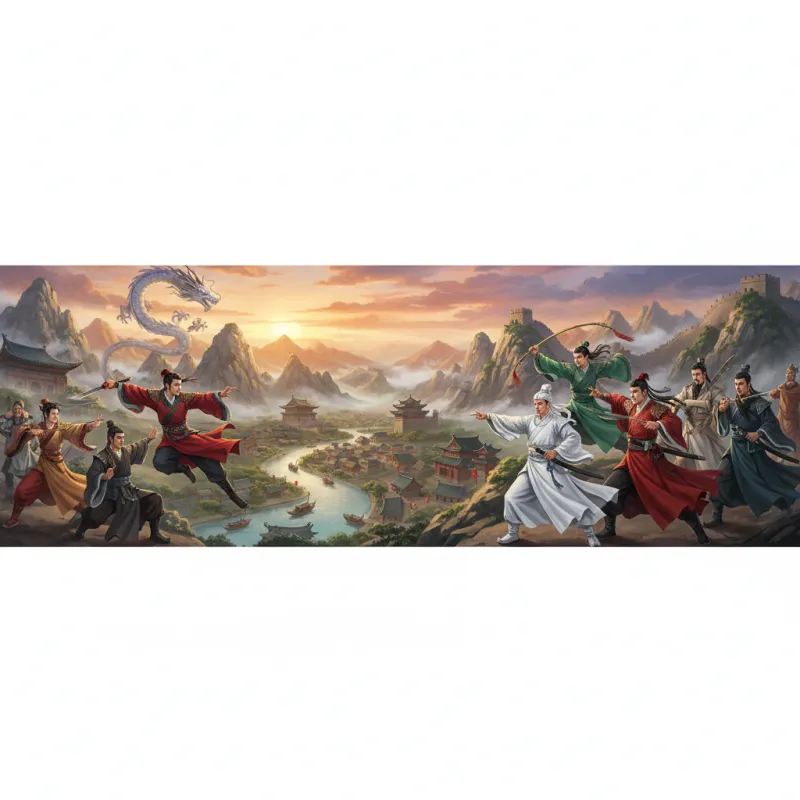
A young beggar stands atop Mount Hua, his palms glowing with an inner force that could shatter stone. Across from him, a blind swordsman moves with impossible grace, his blade singing through mountain mist. This isn't just fantasy—it's the world Jin Yong built across fourteen novels that have sold over 300 million copies and fundamentally reshaped how Chinese people understand heroism, loyalty, and what it means to be human. If you've never cracked open The Legend of the Condor Heroes or watched your grandmother weep over The Return of the Condor Heroes, you're missing out on one of the 20th century's most influential literary phenomena.
The Man Behind the Martial Arts
Louis Cha Leung-yung (查良鏞, Chá Liángyōng), writing under the pen name Jin Yong (金庸, Jīn Yōng), didn't set out to revolutionize Chinese literature. Born in 1924 in Zhejiang Province, he started serializing wuxia novels in his own newspaper, Ming Pao, in 1955 primarily to boost circulation. What began as commercial fiction quickly transcended its pulp origins. Between 1955 and 1972, Jin Yong published fourteen novels that would become the gold standard of the wuxia genre—stories so embedded in Chinese consciousness that references to his characters function as cultural shorthand across generations.
The timing mattered. Post-war Hong Kong was hungry for escapism, but Jin Yong gave readers something more: a reimagined Chinese past where moral complexity trumped simple good-versus-evil narratives. His heroes weren't flawless paragons but deeply flawed individuals wrestling with impossible choices. Guo Jing, the protagonist of The Legend of the Condor Heroes, is famously dim-witted but becomes great through sheer determination and moral clarity. Yang Guo from The Return of the Condor Heroes is arrogant and rebellious, yet his unconventional love story with his teacher Xiaolongnü challenged Confucian orthodoxy in ways that resonated with modernizing Chinese society.
Martial Arts as Philosophy
Here's what sets Jin Yong apart from lesser wuxia writers: his martial arts aren't just cool fight choreography. Every fighting style embodies a philosophical worldview. The Eighteen Dragon-Subduing Palms (降龍十八掌, Jiàng Lóng Shíbā Zhǎng) represents straightforward, overwhelming force—the martial equivalent of Confucian righteousness. The Nine Yin Manual (九陰真經, Jiǔ Yīn Zhēnjīng) contains techniques so powerful they corrupt those who practice them without proper moral foundation, illustrating Daoist warnings about power without wisdom.
Take Dugu Qiubai (獨孤求敗, Dúgū Qiúbài), the legendary swordsman who never appears alive in any novel but whose philosophy permeates Jin Yong's work. His progression through five swords—from sharp blade to heavy iron to wooden sword to no sword at all—mirrors the Buddhist concept of transcending attachment. The ultimate martial artist needs no weapon because they've internalized the principles so completely that everything becomes a weapon. This isn't just clever worldbuilding; it's Jin Yong smuggling Daoist and Buddhist philosophy into adventure stories.
The internal energy cultivation system, or neigong (內功, nèigōng), draws directly from Daoist meditation practices and traditional Chinese medicine concepts. Characters circulate qi (氣, qì) through meridians, break through cultivation bottlenecks, and risk qi deviation (走火入魔, zǒuhuǒ rùmó) if they practice incorrectly. Western readers encountering these concepts through translated novels are essentially getting a crash course in Chinese metaphysics disguised as fantasy fiction.
Women Who Refuse to Be Sidekicks
Jin Yong's female characters deserve their own essay—and indeed, they've sparked decades of academic analysis. Unlike the damsels-in-distress populating earlier wuxia fiction, Jin Yong's women are complex, powerful, and often more interesting than their male counterparts. Huang Rong from The Legend of the Condor Heroes is a genius strategist whose intelligence repeatedly saves the day. Zhao Min from The Heaven Sword and Dragon Saber is a Mongol princess who pursues the man she loves with a determination that flips traditional gender dynamics.
But it's characters like Xiaolongnü and Ren Yingying who really push boundaries. Xiaolongnü's relationship with Yang Guo—she's his teacher, older, and their love violates Confucian propriety—was genuinely shocking when the novel serialized in the 1960s. Readers sent death threats. Jin Yong didn't back down. Similarly, Ren Yingying in The Smiling, Proud Wanderer is the daughter of a demonic cult leader who's more morally upright than many so-called righteous martial artists, forcing readers to question their assumptions about good and evil.
That said, Jin Yong wasn't perfect. His female characters, however capable, often define themselves through relationships with men. The tragic endings many of them face—Azhu's death in Demi-Gods and Semi-Devils, Xiao Zhao's sacrifice in The Heaven Sword and Dragon Saber—can feel like punishment for female agency. Modern readers and critics have rightfully called this out, even while acknowledging that Jin Yong was progressive for his time and context.
Historical Fiction That Rewrites History
Jin Yong set his novels across different Chinese dynasties—Song, Yuan, Ming, Qing—and he did his homework. The historical details are meticulous: political intrigues, military campaigns, ethnic tensions between Han Chinese and various northern peoples. The Legend of the Condor Heroes unfolds against the Mongol conquest of China, with real historical figures like Genghis Khan and his sons appearing alongside fictional martial artists. Guo Jing's ultimate fate—dying while defending Xiangyang against Mongol forces—ties fictional heroism to actual historical tragedy.
But Jin Yong wasn't writing history textbooks. He used historical settings to explore contemporary concerns. The Deer and the Cauldron, his final and most subversive novel, features Wei Xiaobao, an amoral trickster who succeeds through cunning rather than martial prowess. Set during the early Qing dynasty, it's really about Hong Kong's identity crisis—caught between Chinese tradition and British colonial influence, between idealism and pragmatism. Wei Xiaobao, who serves both the Qing emperor and the anti-Qing resistance, embodies that ambiguity.
The novels also grapple with Chinese nationalism in nuanced ways. While early works like The Legend of the Condor Heroes present clear Han Chinese versus foreign invader dynamics, later novels complicate this. Demi-Gods and Semi-Devils features Qiao Feng, a Khitan warrior raised as Han Chinese, whose tragic arc explores the futility of ethnic hatred. When he discovers his true heritage, both communities reject him. His suicide—choosing death over fighting for either side—is Jin Yong's most powerful statement against nationalism's destructive force.
The Jianghu: A World Apart
The jianghu (江湖, jiānghú)—literally "rivers and lakes"—is the parallel society where Jin Yong's martial artists operate. It's not quite the criminal underworld, not quite a secret society, but something uniquely Chinese: a space outside official government control where personal honor, martial skill, and sect loyalty matter more than legal authority. Understanding the jianghu is essential to understanding why these novels resonate so deeply.
The jianghu has its own rules, hierarchies, and moral codes. The concept of wulin (武林, wǔlín), the martial arts community, includes various sects and schools—Shaolin Temple, Wudang Sect, Emei Sect—each with distinct philosophies and techniques. Conflicts arise not from simple villainy but from competing codes of honor, old grudges, and philosophical disagreements about what martial arts should serve. The distinction between the "orthodox" (正派, zhèngpài) and "unorthodox" (邪派, xiépài) sects is constantly questioned throughout Jin Yong's work, with supposedly righteous characters committing atrocities and demonic cult members displaying nobility.
This jianghu worldview has profoundly influenced how Chinese people conceptualize alternative social structures. When modern Chinese talk about workplace politics or social networks using jianghu terminology, they're drawing on frameworks Jin Yong popularized. The idea that there are unwritten rules more important than official ones, that personal loyalty trumps institutional authority—these are jianghu values that Jin Yong's novels reinforced in popular consciousness.
Cultural Legacy Beyond the Page
Jin Yong's influence extends far beyond literature. His novels have been adapted into countless television series, films, comics, video games, and even theme parks. Actors who've played his characters—like Barbara Yung's iconic Huang Rong or Louis Koo's Yang Guo—become permanently associated with those roles. The 1983 TVB adaptation of The Legend of the Condor Heroes is considered one of Hong Kong television's greatest achievements, its theme song instantly recognizable across the Chinese-speaking world.
The novels have also sparked serious academic study. Universities offer courses analyzing Jin Yong's work through literary, philosophical, and cultural lenses. Scholars debate whether his novels constitute "serious literature" or remain popular fiction—a distinction Jin Yong himself found amusing. His integration of classical Chinese poetry, historical knowledge, and philosophical concepts into accessible narratives has made his work a bridge between high and low culture.
For the Chinese diaspora, Jin Yong's novels serve as cultural touchstones. A Chinese person growing up in Malaysia, Canada, or Peru likely encountered these stories through television adaptations or translations, creating shared reference points across vastly different lived experiences. Discussing favorite characters or debating which adaptation was most faithful becomes a way of affirming cultural identity. The novels have been translated into English, French, Spanish, and other languages, though they've never achieved the same global recognition as, say, Japanese manga—perhaps because the cultural context is so specifically Chinese that much gets lost in translation.
Why Jin Yong Still Matters
Jin Yong passed away in 2018 at age 94, but his literary legacy continues evolving. New generations discover his novels through different media—video games like Gujian Qitan and Sword and Fairy draw heavily on wuxia conventions Jin Yong codified. Contemporary Chinese fantasy writers, whether writing cultivation novels (修真小說, xiūzhēn xiǎoshuō) or historical fiction, work in Jin Yong's shadow, either emulating or deliberately subverting his tropes.
What makes Jin Yong's work endure isn't just the exciting fight scenes or intricate plots—though those help. It's that he used martial arts fantasy to explore timeless questions about loyalty, justice, love, and identity. His characters face impossible moral dilemmas: Do you avenge your parents if it means killing innocents? Can love transcend social boundaries? Is it better to die with honor or live with compromise? These questions don't have easy answers, and Jin Yong never pretends they do.
For readers interested in exploring further, The Legend of the Condor Heroes remains the best starting point—it introduces core concepts while telling a complete, satisfying story. Those wanting something more philosophically complex might jump to Demi-Gods and Semi-Devils, while readers who prefer morally ambiguous protagonists should try The Smiling, Proud Wanderer. Whatever you choose, you're entering a world that has captivated hundreds of millions of readers and fundamentally shaped modern Chinese popular culture. The jianghu awaits.
Related Reading
- The Smiling, Proud Wanderer: A Complete Guide
- The Legend of the Condor Heroes: A Complete Reader's Guide
- The Deer and the Cauldron: Jin Yong's Comic Masterpiece
- A Reader's Guide to All 14 Jin Yong Novels
- Fox Volant of the Snowy Mountain: A Tale of Revenge
- The Humor of Jin Yong: Comedy in the Martial World
- Exploring the Enigmatic Worlds of Jin Yong's Wuxia Novels
- Exploring Legendary Weapons in Jin Yong’s Wuxia Novels: Symbolism and Martial Arts Mastery