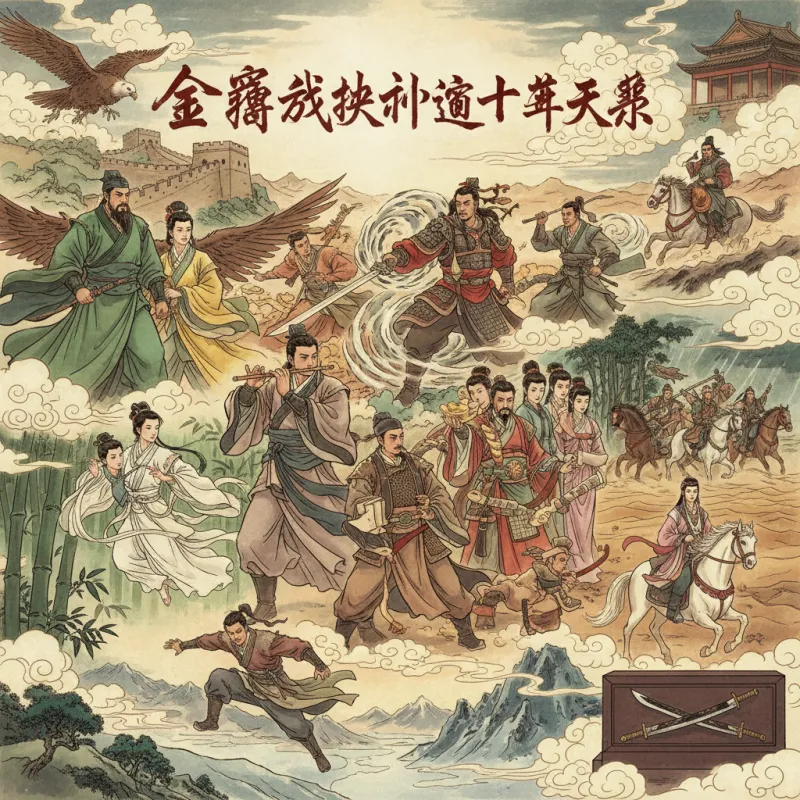
You've probably heard that Jin Yong wrote fourteen novels. What you might not know is that he encoded all fourteen titles into a single poetic couplet—飞雪连天射白鹿,笑书神侠倚碧鸳 (Fēi xuě lián tiān shè bái lù, xiào shū shén xiá yǐ bì yuān)—and then never wrote another wuxia novel again. Between 1955 and 1972, he built an entire literary universe, established the modern wuxia genre, and walked away at the height of his powers. This guide breaks down all fourteen novels: what makes each one essential, which order to read them in, and why Jin Yong's self-imposed retirement might be the most badass move in Chinese literature.
The Condor Trilogy: Start Here If You Want the Full Experience
射雕英雄传 (Shèdiāo Yīngxióng Zhuàn) — The Legend of the Condor Heroes (1957-1959)
This is where Jin Yong found his voice. Guo Jing (郭靖 Guō Jìng), a simple-minded but loyal hero, grows from Mongolian steppes orphan to defender of China against Genghis Khan's armies. His romance with the brilliant Huang Rong (黄蓉 Huáng Róng) remains one of wuxia's most beloved pairings—she's clever enough for both of them, and he's principled enough to anchor her schemes.
What makes this novel work is its scope. Jin Yong weaves real historical figures (Genghis Khan, the Song Dynasty's collapse) with martial arts fantasy, creating a template he'd refine for seventeen years. The Seven Freaks of Jiangnan (江南七怪 Jiāngnán Qī Guài), the Peach Blossom Island (桃花岛 Táohuā Dǎo) setting, the introduction of the Eighteen Dragon-Subduing Palms (降龙十八掌 Xiánglóng Shíbā Zhǎng)—this novel establishes the geography and martial arts lineages that echo through Jin Yong's entire body of work.
神雕侠侣 (Shéndiāo Xiálǚ) — The Return of the Condor Heroes (1959-1961)
Set one generation after Condor Heroes, this novel takes everything comfortable about its predecessor and burns it down. Yang Guo (杨过 Yáng Guò), son of a traitor, falls in love with his teacher Xiao Longnü (小龙女 Xiǎo Lóngnǚ). Their relationship violates every Confucian taboo, and Jin Yong doesn't flinch. The sixteen-year separation, the missing arm, the moral ambiguity—this is where Jin Yong proved he could write tragedy as well as adventure.
If Condor Heroes is about becoming a hero through virtue, Return asks whether virtue even matters when society's rules are corrupt. Yang Guo is bitter, brilliant, and deeply flawed. He's also more interesting than his father's friend Guo Jing ever was. The novel's willingness to challenge traditional morality makes it feel modern even today.
倚天屠龙记 (Yǐtiān Túlóng Jì) — The Heaven Sword and Dragon Saber (1961-1963)
The trilogy concludes with Zhang Wuji (张无忌 Zhāng Wújì), possibly Jin Yong's most indecisive protagonist. He can't choose between four women who all love him, can't decide whether to lead the Ming Cult (明教 Míng Jiào), and generally spends 1,200 pages being pulled in every direction. Some readers find this frustrating. I think it's the point.
Heaven Sword is about the impossibility of heroism in a fractured world. The martial arts sects are corrupt, the Mongol Yuan Dynasty is collapsing, and everyone wants the legendary weapons that give the novel its title. Zhang Wuji masters the Nine Yang Manual (九阳真经 Jiǔyáng Zhēnjīng) and the Heaven and Earth Great Shift (乾坤大挪移 Qiánkūn Dà Nuóyí), becoming nearly invincible—but power doesn't solve his problems. It's a surprisingly mature ending to a trilogy that began with straightforward heroism.
The Philosophical Masterpieces
天龙八部 (Tiānlóng Bābù) — Demi-Gods and Semi-Devils (1963-1966)
Jin Yong's most ambitious novel, named after Buddhist cosmology's eight classes of non-human beings. Three protagonists—Duan Yu (段誉 Duàn Yù), Xuzhu (虚竹 Xūzhú), and Qiao Feng (乔峰 Qiáo Fēng)—navigate identity, fate, and the futility of violence. Qiao Feng's arc alone, from respected Beggar Clan leader to tragic figure caught between Chinese and Khitan identities, justifies the novel's 1,300-page length.
This is Jin Yong at his most Buddhist. Every character suffers from attachment, ignorance, or karma. The martial arts are spectacular—the Six Meridians Divine Sword (六脉神剑 Liùmài Shénjiàn), the Beiming Divine Art (北冥神功 Běimíng Shéngōng)—but they can't save anyone from themselves. For deeper analysis, see Demi-Gods and Semi-Devils: A Complete Guide.
笑傲江湖 (Xiào'ào Jiānghú) — The Smiling, Proud Wanderer (1967-1969)
No historical setting. No clear time period. Just pure political allegory. Linghu Chong (令狐冲 Línghú Chōng) wants to drink wine, play music, and avoid responsibility. Instead, he gets caught in a power struggle that destroys the orthodox martial arts sects from within.
Jin Yong wrote this during the Cultural Revolution, and it shows. The novel's villains aren't foreign invaders—they're ambitious sect members who weaponize orthodoxy to seize power. Yue Buqun (岳不群 Yuè Bùqún), Linghu Chong's master, becomes one of wuxia's greatest villains precisely because his fall feels inevitable. The novel asks: what happens when the system itself is corrupt? Linghu Chong's answer—withdraw, stay true to yourself, find freedom outside society—resonated with readers living through political chaos.
鹿鼎记 (Lùdǐng Jì) — The Deer and the Cauldron (1969-1972)
Jin Yong's final novel is also his strangest. Wei Xiaobao (韦小宝 Wéi Xiǎobǎo) is a brothel-raised conman with no martial arts skills, no principles, and no interest in heroism. He lies, cheats, and stumbles his way into becoming the Kangxi Emperor's closest friend. It's a comedy, a satire, and a deconstruction of everything Jin Yong spent seventeen years building.
After writing thirteen novels about heroes, Jin Yong ended with an anti-hero who succeeds precisely because he ignores wuxia's moral codes. Wei Xiaobao is loyal to friends, not ideals. He's practical, not principled. And he gets seven wives and a happy ending while traditional heroes die tragically. The novel's cynicism shocked readers in 1972. Today, it feels prophetic—a recognition that survival often requires compromise, and that heroism is a luxury most people can't afford.
The Historical Adventures
碧血剑 (Bìxuè Jiàn) — Sword Stained with Royal Blood (1956)
Jin Yong's second novel, set during the Ming Dynasty's collapse. Yuan Chengzhi (袁承志 Yuán Chéngzhì) seeks revenge for his father's death while the Manchu invasion looms. It's competent but overshadowed by Jin Yong's later work. The novel's strength is its historical detail—the fall of the Ming feels inevitable, and Yuan Chengzhi's personal revenge plot seems trivial against dynastic collapse.
雪山飞狐 (Xuěshān Fēihú) — Flying Fox of Snowy Mountain (1959)
A novella, really—Jin Yong's shortest work at around 120,000 characters. Hu Fei (胡斐 Hú Fēi) investigates his father's death in a mystery structure unusual for wuxia. The novel ends on a cliffhanger, with Hu Fei's blade frozen mid-strike. Jin Yong never resolves it, which is either brilliant or infuriating depending on your tolerance for ambiguity.
飞狐外传 (Fēihú Wàizhuàn) — The Young Flying Fox (1960-1961)
A prequel/sequel to Flying Fox, following Hu Fei's earlier adventures. The romance with Yuan Ziyi (袁紫衣 Yuán Zǐyī), a nun, adds emotional depth. The novel explores how Hu Fei became the man frozen in that cliffhanger moment, though it still doesn't resolve the original ending.
白马啸西风 (Báimǎ Xiào Xīfēng) — White Horse Neighing in the West Wind (1961)
Another novella, set in China's western regions. Li Wenxiu (李文秀 Lǐ Wénxiù), a Han Chinese girl raised by Kazakhs, loves a man who doesn't love her back. It's melancholic and understated, ending with one of Jin Yong's most quoted lines: "That's wonderful, but I don't care for it" (那都很好,可是我偏不喜欢 Nà dōu hěn hǎo, kěshì wǒ piān bù xǐhuān). A meditation on unrequited love and cultural displacement.
The Early Experiments
书剑恩仇录 (Shūjiàn Ēnchóu Lù) — The Book and the Sword (1955)
Jin Yong's first novel, and it shows. Chen Jialuo (陈家洛 Chén Jiāluò) leads the Red Flower Society (红花会 Hónghuā Huì) against the Qing Dynasty. The plot is convoluted, the pacing uneven, but you can see Jin Yong learning his craft. The novel's historical speculation—that the Qianlong Emperor was actually Han Chinese—became one of wuxia's most enduring conspiracy theories.
连城诀 (Liánchéng Jué) — A Deadly Secret (1963)
Jin Yong's darkest novel. Ding Dian (丁典 Dīng Diǎn) and Di Yun (狄云 Dí Yún) suffer betrayal after betrayal in a story about greed destroying everything decent. There are no comic relief characters, no triumphant victories. Just cruelty, misunderstanding, and the occasional moment of grace. It's brilliant and deeply unpleasant—Jin Yong proving he could write noir as well as epic fantasy.
侠客行 (Xiákè Xíng) — Ode to Gallantry (1965)
A nameless protagonist (literally—he doesn't know his own name) stumbles into martial arts mysteries on Chivalrous Island (侠客岛 Xiákè Dǎo). The novel plays with identity and the gap between reputation and reality. It's lighter than A Deadly Secret but shares that novel's interest in how stories shape perception. The martial arts manual everyone seeks turns out to be a poem about freedom, not a fighting technique—very Jin Yong.
How to Read Them: Three Paths
The Completist: Chronological order by publication. Start with The Book and the Sword, watch Jin Yong evolve, end with The Deer and the Cauldron's deconstruction of everything that came before.
The Pragmatist: Begin with The Legend of the Condor Heroes, read the Condor Trilogy, then jump to Demi-Gods and Semi-Devils and The Smiling, Proud Wanderer. Fill in the rest based on interest. This gets you the essential Jin Yong experience in five novels.
The Contrarian: Start with The Deer and the Cauldron. If you love Wei Xiaobao's cynical comedy, work backward to see what Jin Yong was deconstructing. If you hate it, you'll appreciate the earlier novels' earnest heroism even more.
Why He Stopped
In 1972, Jin Yong finished The Deer and the Cauldron and announced he'd never write another wuxia novel. He spent the next decades revising his existing work, but he kept his word. Why stop at the peak of his powers?
Maybe because The Deer and the Cauldron said everything left to say. After thirteen novels building the wuxia genre's conventions, Jin Yong wrote a fourteenth that questioned whether any of it mattered. Wei Xiaobao succeeds by ignoring everything Jin Yong taught readers to value. There's nowhere to go after that except repetition or self-parody.
Or maybe Jin Yong understood that fourteen was enough. The couplet he created from his titles is complete, symmetrical, perfect. Adding a fifteenth novel would break the pattern. Sometimes the most powerful move is knowing when to stop.
Related Reading
- The Legend of the Condor Heroes: A Complete Reader's Guide
- Journey Through Jin Yong's Wuxia Novels: Martial Arts, Characters, and Cultural Legacy
- The Book and the Sword: Jin Yong's First Novel
- The Heaven Sword and Dragon Saber: A Complete Guide
- Exploring the Enigmatic Worlds of Jin Yong's Wuxia Novels
- Exploring Jin Yong's Wuxia Novels: Characters, Martial Arts, and Storylines
- Exploring the Rich Tapestry of Jin Yong's Wuxia Novels and Their Enduring Legacy