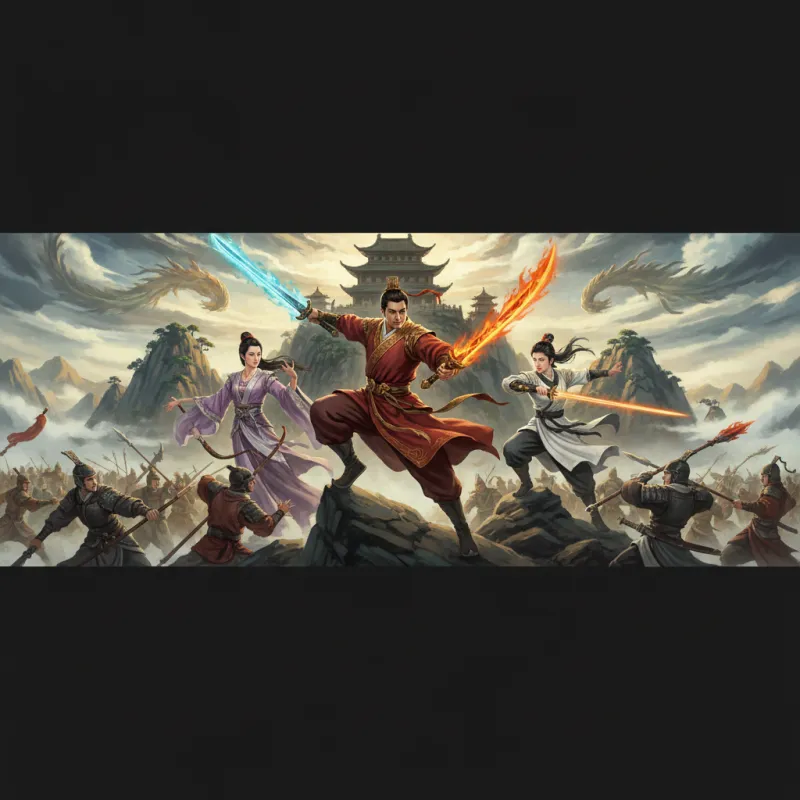
Zhang Wuji stands paralyzed between four women who love him, unable to choose, unable to act, unable to do anything except radiate pure protagonist energy while the fate of China hangs in the balance. If you've ever wondered what happens when you give godlike martial arts powers to someone with the decisiveness of a wet noodle, 倚天屠龙记 (Yǐtiān Túlóng Jì, The Heaven Sword and Dragon Saber) is your answer—and somehow, it's Jin Yong's most addictive novel.
The Setup: Two Weapons, One Prophecy, Zero Chill
Set during the Mongol Yuan Dynasty (1271-1368), roughly a century after The Return of the Condor Heroes, the martial arts world has descended into chaos. The legendary couple Guo Jing and Huang Rong are long dead, their sacrifice at Xiangyang now the stuff of myth. What remains are their weapons: the Heaven Sword (倚天剑 Yǐtiān Jiàn) and the Dragon Saber (屠龙刀 Túlóng Dāo), forged from Yang Guo's Dark Iron Heavy Sword and imbued with secrets that could "command the jianghu."
The prophecy everyone obsesses over goes: "武林至尊,宝刀屠龙。号令天下,莫敢不从。倚天不出,谁与争锋" (Wǔlín zhìzūn, bǎodāo túlóng. Hàolìng tiānxià, mò gǎn bù cóng. Yǐtiān bù chū, shéi yǔ zhēng fēng)—"Supreme in the martial arts world is the precious Dragon Saber. It commands the world, none dare disobey. If the Heaven Sword does not appear, who can compete?" It's basically the jianghu version of a treasure map, and everyone wants in.
But here's Jin Yong's genius: the weapons are MacGuffins. The real story is about Zhang Wuji, a kid who gets poisoned with Xuanming Divine Palm's cold energy at age ten, spends years suffering, accidentally learns the Nine Yang Divine Skill (九阳神功 Jiǔyáng Shéngōng), becomes leader of the Ming Cult (明教 Míngjiào), and still can't figure out which girl he likes. The weapons? They're just the excuse to throw him into increasingly complicated situations.
Zhang Wuji: The Protagonist Who Can't Protagonist
Let's be honest: Zhang Wuji is frustrating. He's the grandson of Wudang's Zhang Sanfeng (张三丰 Zhāng Sānfēng), godson to the Golden Lion King Xie Xun (谢逊 Xiè Xùn), master of multiple supreme martial arts, and leader of the most powerful organization in the jianghu. He should be unstoppable. Instead, he's the human embodiment of "I don't know, what do you want to do?"
Four women fall for him: Zhou Zhiruo (周芷若 Zhōu Zhǐruò), the sweet Emei disciple who transforms into something terrifying; Zhao Min (赵敏 Zhào Mǐn), the Mongol princess who's smarter than everyone in the room; Yin Li (殷离 Yīn Lí), the tragic figure who loves him from childhood; and Xiao Zhao (小昭 Xiǎo Zhāo), the Persian Ming Cult maiden who's too good for this mess. Zhang Wuji's response to all of them? "Uh... I care about all of you?"
Yet this indecisiveness is the point. Jin Yong wrote Heaven Sword in 1961, at the height of his powers, and Zhang Wuji represents something different from his other heroes. He's not the righteous Guo Jing or the rebellious Yang Guo. He's a fundamentally kind person thrust into leadership, someone who wants to save everyone and hurt no one—an impossible goal in the brutal world of jianghu politics. His paralysis isn't weakness; it's the tragedy of someone too empathetic for the role history demands.
The Women: Jin Yong's Most Complex Female Characters
If Zhang Wuji is frustrating, the women around him are fascinating. Zhou Zhiruo's transformation from innocent girl to calculating manipulator remains one of Jin Yong's most controversial character arcs. After being humiliated and betrayed, she seizes power through the Nine Yin Manual (九阴真经 Jiǔyīn Zhēnjīng) and becomes exactly what the jianghu made her: ruthless. Readers either despise her or recognize her as a victim of circumstance. There's no middle ground.
Zhao Min, meanwhile, is the novel's secret weapon. She's the antagonist who becomes the love interest, the Mongol princess who falls for a Han Chinese rebel, the woman who consistently outsmarts everyone while making it look effortless. When she crashes Zhang Wuji's wedding to Zhou Zhiruo and asks, "If I jump off this cliff, will you regret it?"—that's not manipulation. That's a woman who knows exactly what she wants and refuses to settle for less. She's the anti-Zhou Zhiruo: instead of being broken by the jianghu, she bends it to her will.
The tragedy belongs to Yin Li and Xiao Zhao, the women who love Zhang Wuji selflessly and get nothing in return. Yin Li dies saving him. Xiao Zhao becomes the Persian Ming Cult leader and sails away, knowing he'll never choose her. Jin Yong doesn't give them happy endings because that's not how the world works—especially not for women in the Yuan Dynasty, and especially not in a story about the cost of indecision.
The Ming Cult and Historical Resonance
The Ming Cult (明教 Míngjiào) is Jin Yong's fictionalized version of Manichaeism, the Persian dualistic religion that actually existed in medieval China. By making it the foundation of the anti-Yuan resistance, Jin Yong connects his wuxia fantasy to real history: the Ming Dynasty (1368-1644) that eventually overthrew the Mongols did emerge from secret societies and religious movements.
Zhang Wuji becomes the cult's 34th leader almost by accident, but his leadership style—reluctant, inclusive, focused on unity over dominance—mirrors the novel's central theme. The Ming Cult's six major sects and various factions spend more time fighting each other than the Mongols, a pointed commentary on how resistance movements self-destruct through internal conflict. Sound familiar? Jin Yong was writing in 1961, watching political movements fracture in real-time.
The cult's headquarters at Bright Peak (光明顶 Guāngmíng Dǐng) and the secret passage through Kunlun Mountain create some of the novel's most memorable set pieces. But the real power of the Ming Cult storyline is how it forces Zhang Wuji to grow up. He can't just be a good person anymore; he has to make impossible choices about who lives, who dies, and what principles are worth sacrificing for victory.
The Weapons' Secret: Anticlimax as Art
After 800+ pages of everyone killing each other over the Heaven Sword and Dragon Saber, the secret inside them is... military strategy manuals and the Nine Yin Manual. That's it. No mystical power, no ancient treasure, just books. The Dragon Saber contains Yue Fei's military treatise Wumu's Testament (武穆遗书 Wǔmù Yíshū) and the Nine Yin Manual. The Heaven Sword holds the Eighteen Dragon-Subduing Palms (降龙十八掌 Jiàng Lóng Shíbā Zhǎng) and the Dog-Beating Staff Technique (打狗棒法 Dǎgǒu Bàngfǎ).
Readers expecting some world-shattering revelation often feel cheated. But Jin Yong knew exactly what he was doing. The weapons' mundane contents prove that the jianghu's obsessions are hollow. People died for books that were already available elsewhere. The prophecy was just Guo Jing and Huang Rong's way of preserving knowledge, not a promise of power. The real treasure was always the friends we murdered along the way.
This anticlimax mirrors Zhang Wuji's journey. He spends the novel searching for answers—about his parents' deaths, about the weapons, about which woman to choose—only to discover that some questions don't have satisfying answers. Life isn't a prophecy with a clear resolution. It's messy, ambiguous, and often disappointing. The novel's ending, with Zhang Wuji and Zhao Min sailing away while Zhou Zhiruo enters a nunnery, doesn't tie everything up neatly because Jin Yong refuses to pretend that's how life works.
Why It Endures: The Trilogy's Emotional Climax
Heaven Sword and Dragon Saber completes the Condor Trilogy's generational saga. The Legend of the Condor Heroes gave us idealism and heroism. The Return of the Condor Heroes gave us rebellion and romance. Heaven Sword gives us consequence and compromise. The heroes of the first two novels are dead. Their weapons have become objects of greed. Their ideals have curdled into factional warfare. And their descendant, Zhang Wuji, must navigate a world where being a good person isn't enough.
The novel's enduring popularity—despite Zhang Wuji's maddening indecisiveness—comes from its emotional honesty. Jin Yong doesn't pretend that love conquers all or that the righteous always win. Zhou Zhiruo's descent into darkness, Zhao Min's willingness to abandon her family, Xie Xun's blindness and redemption, Zhang Sanfeng's grief over his disciple's betrayal—these moments hurt because they feel true. The jianghu isn't a playground for heroes. It's a meat grinder that destroys everyone who enters it, and the best you can hope for is to escape with your humanity intact.
The Verdict: Flawed, Frustrating, Unforgettable
Is Zhang Wuji the most annoying protagonist in Jin Yong's bibliography? Absolutely. Does the novel's pacing drag in the middle sections? Yes. Is the weapons' secret a letdown? Depends on what you expected. But does The Heaven Sword and Dragon Saber earn its place as one of Jin Yong's masterpieces? Without question.
It's the novel where Jin Yong stopped writing pure heroes and started writing real people—flawed, conflicted, capable of both nobility and selfishness. It's where he took the wuxia genre's obsession with legendary weapons and asked, "What if the real treasure was worthless?" It's where he created some of his most complex female characters and refused to give them the endings readers wanted.
Most importantly, it's the novel that proves the Condor Trilogy was never about martial arts supremacy or romantic destiny. It was always about how each generation inherits the previous one's failures and must find their own way forward. Zhang Wuji isn't Guo Jing. He can't be. The world has changed, and the old heroic certainties don't work anymore. His indecisiveness isn't a character flaw—it's the only honest response to an impossible situation.
That's why, sixty years after publication, we're still arguing about whether he should have chosen Zhou Zhiruo or Zhao Min. Jin Yong made sure there was no right answer.
Related Reading
- Demi-Gods and Semi-Devils: A Complete Guide
- A Reader's Guide to All 14 Jin Yong Novels
- Fox Volant of the Snowy Mountain: A Tale of Revenge
- The Book and the Sword: Jin Yong's First Novel
- Journey Through Jin Yong's Wuxia Novels: Martial Arts, Characters, and Cultural Legacy
- The Xiao Ao Jianghu Theme Song: Music as Philosophy
- Jin Yong's Quotes That Every Chinese Person Knows
- The Definitive Jin Yong Martial Arts Power Ranking