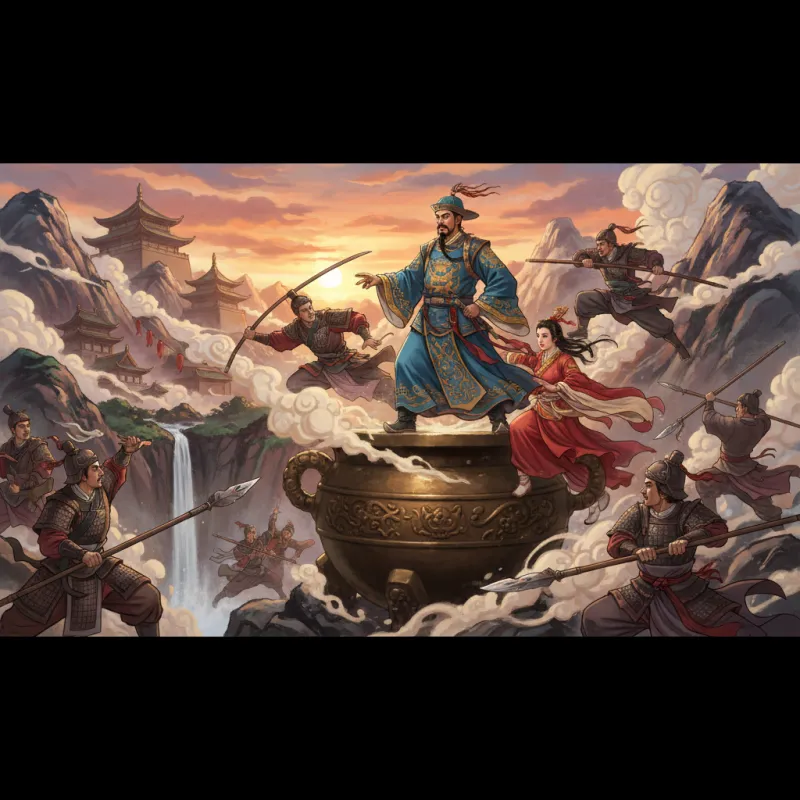
What if the greatest martial arts novel ever written was actually a comedy that mocked everything martial arts novels stood for? That's exactly what Jin Yong did with "The Deer and the Cauldron" (鹿鼎記, Lù Dǐng Jì), his final and most subversive work. After spending two decades crafting noble heroes like Guo Jing and Yang Guo, Jin Yong closed his career in 1972 with Wei Xiaobao—a lying, gambling, womanizing street urchin who can't fight to save his life. It was the literary equivalent of a master chef serving a hot dog at a Michelin-starred restaurant, and somehow, it worked brilliantly.
The Anti-Hero Who Changed Everything
Wei Xiaobao (韋小寶) is everything a wuxia protagonist shouldn't be. He has zero martial arts skills, no moral compass, and his primary talents involve flattery, deception, and running away from danger. Compare him to the heroes of The Legend of the Condor Heroes or Demi-Gods and Semi-Devils, and you'll find he shares nothing with them except breathing. Where Guo Jing embodied loyalty and righteousness, Wei Xiaobao embodies opportunism. Where Duan Yu refused to kill, Wei Xiaobao stabs people in the back—literally.
Yet this scoundrel becomes one of Jin Yong's most beloved characters. Why? Because he's honest about his dishonesty. In a genre filled with hypocritical martial artists who kill in the name of justice, Wei Xiaobao's shameless self-interest feels refreshingly authentic. He doesn't pretend to be a hero, and that makes him more human than the paragons who came before him.
Comedy as Social Commentary
Jin Yong didn't write "The Deer and the Cauldron" just for laughs—he used comedy as a scalpel to dissect Chinese society and politics. Set during the early Qing Dynasty (1644-1912), the novel follows Wei Xiaobao as he stumbles into the Kangxi Emperor's inner circle, joins the anti-Qing Heaven and Earth Society (天地會, Tiān Dì Huì), and somehow manages to serve both sides without getting caught.
The satire cuts deep. The Heaven and Earth Society, supposedly fighting for the restoration of the Ming Dynasty, is revealed as a collection of incompetent blowhards more interested in titles and face than actual revolution. The martial arts world (江湖, jiānghú), traditionally portrayed as a realm of honor and righteousness, becomes a cesspool of petty rivalries and self-deception. Even the Qing court, with all its power and ceremony, is shown to be vulnerable to the manipulations of a clever street rat.
This wasn't just historical satire—readers in 1970s Hong Kong understood the contemporary parallels. Jin Yong was commenting on political movements, ideological purity, and the gap between revolutionary rhetoric and human reality. The novel asked uncomfortable questions: What if your heroes are frauds? What if loyalty is just another word for being used? What if survival requires compromise?
The康熙 Emperor: History Meets Fiction
One of the novel's boldest moves was making the Kangxi Emperor (康熙帝) a major character and, surprisingly, one of the most sympathetic figures in the story. The historical Kangxi (reigned 1661-1722) was one of China's greatest emperors, but Jin Yong humanizes him through his friendship with Wei Xiaobao.
Their relationship is the emotional core of the novel. Kangxi, despite being the emperor, is isolated and lonely, surrounded by sycophants and protocol. Wei Xiaobao, despite being a commoner and a fraud, treats him like a real person. They gamble together, joke together, and genuinely care for each other—even though Wei Xiaobao is secretly a member of an anti-Qing organization sworn to overthrow Kangxi's dynasty.
This friendship creates the novel's central tension. Wei Xiaobao must choose between his sworn brothers in the Heaven and Earth Society and his genuine affection for Kangxi. Jin Yong refuses to provide an easy answer. Unlike his earlier novels where righteousness (義, yì) provided clear moral guidance, "The Deer and the Cauldron" exists in shades of gray. Both sides have legitimate claims, both sides are flawed, and Wei Xiaobao's solution—to avoid choosing—feels like the only honest response.
Seven Wives and the Subversion of Romance
Wei Xiaobao ends up with seven wives, which sounds like a male fantasy until you realize Jin Yong is satirizing that very fantasy. Each wife represents a different martial arts novel archetype: the innocent maiden, the fierce warrior woman, the seductive temptress, the noble princess. But instead of the typical romantic storylines, Jin Yong shows the absurdity and complications of trying to manage seven strong-willed women.
The wives argue, compete for attention, and form alliances against each other. Wei Xiaobao, far from being a masterful patriarch, spends most of his time trying to avoid their wrath and prevent them from discovering his lies. It's a far cry from the idealized romances in novels like The Return of the Condor Heroes, where love conquers all. Here, love is messy, complicated, and often ridiculous.
What makes this work is that the wives aren't just comic props—they're fully realized characters with their own agency. A'ke (阿珂) remains obsessed with another man throughout the marriage. Shuang'er (雙兒) is the only one who truly understands Wei Xiaobao's nature and loves him anyway. Princess Jianning (建寧公主) is a sadistic aristocrat who treats Wei Xiaobao like a toy. These aren't passive women waiting to be rescued; they're active participants in the chaos.
The Absence of Martial Arts in a Martial Arts Novel
Perhaps the most radical aspect of "The Deer and the Cauldron" is that its protagonist never learns martial arts. In a genre defined by elaborate fight scenes and mystical techniques, Wei Xiaobao wins through luck, trickery, and running away. When he does fight, it's usually by throwing lime powder in someone's eyes or stabbing them when they're not looking.
This absence is the point. Jin Yong spent twenty years writing about martial arts mastery, from the Eighteen Dragon-Subduing Palms (降龍十八掌, Jiàng Lóng Shíbā Zhǎng) to the Nine Yin Manual (九陰真經, Jiǔ Yīn Zhēn Jīng). By the time he wrote "The Deer and the Cauldron," he seemed to be asking: What does all this martial prowess actually accomplish? His earlier heroes used their skills to uphold justice, but they often ended up dead or disillusioned. Wei Xiaobao, with no skills at all, survives and thrives.
It's a devastating critique of the entire wuxia genre. All those years of training, all that talk of honor and righteousness—and in the end, the survivor is the one who never bought into any of it. The novel suggests that in the real world, adaptability beats principle, and knowing when to run beats knowing how to fight.
Legacy and Controversy
"The Deer and the Cauldron" divided Jin Yong's fanbase. Purists who loved his earlier works felt betrayed by the shift in tone and the unheroic protagonist. They wanted another Guo Jing, not a con artist. But others recognized it as Jin Yong's most mature and sophisticated work—a novel that questioned the very foundations of the genre he had mastered.
The book's influence extends beyond literature. It's been adapted into numerous films and television series, with each generation finding new relevance in Wei Xiaobao's story. In an era of increasing cynicism about politics and institutions, a protagonist who trusts nothing and no one feels remarkably contemporary.
Jin Yong himself seemed to view "The Deer and the Cauldron" as a farewell to the wuxia genre. After completing it in 1972, he never wrote another martial arts novel, spending his remaining years revising his existing works. It's as if he had said everything he needed to say, and the final statement was: Don't take any of this too seriously, including the person telling you not to take it seriously.
Why It Matters Today
"The Deer and the Cauldron" endures because it's fundamentally about survival in a world where the rules don't make sense and the authorities can't be trusted. Wei Xiaobao succeeds not by being strong or righteous, but by being flexible and pragmatic. He reads situations, adapts to circumstances, and never commits fully to any ideology that might get him killed.
This resonates in any era, but especially in times of political uncertainty and social upheaval. The novel doesn't offer easy answers or moral certainties. Instead, it suggests that sometimes the best you can do is muddle through, protect the people you care about, and try not to get caught in the machinery of history.
Jin Yong's comic masterpiece is ultimately a deeply humanistic work. By stripping away the fantasy of martial arts invincibility and moral clarity, he revealed something true about human nature: We're all just trying to survive, and the ones who admit it might be more honest than the ones who claim to be heroes.
Related Reading
- Demi-Gods and Semi-Devils: A Complete Guide
- Journey Through Jin Yong's Wuxia Novels: Martial Arts, Characters, and Cultural Legacy
- The Legend of the Condor Heroes: A Complete Reader's Guide
- A Reader's Guide to All 14 Jin Yong Novels
- The Complete Guide to Jin Yong: Master of Wuxia Fiction
- The Unsung Heroes of Jin Yong's Wuxia Novels: Side Characters That Steal the Spotlight
- Exploring the Enduring Legacy of Jin Yong's Wuxia Novels
- Exploring Legendary Weapons in Jin Yong’s Wuxia Novels: Symbolism and Martial Arts Mastery